Get Full Government Meeting Transcripts, Videos, & Alerts Forever!
Get email alerts on the Signs topic
No spam. Unsubscribe anytime.
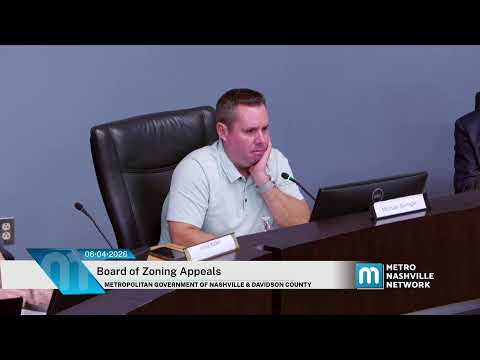
Board approves Cornerstone Church digital billboard variance over planning objections
Summary
The Metro Nashville Board of Zoning Appeals approved a variance allowing Cornerstone Church to install a digital billboard at 726 Old Hickory Boulevard West, after debate over separation distance from residentially zoned property, photometric impact and whether the approved SP had anticipated a digital sign.
The Metro Nashville Board of Zoning Appeals voted to approve a variance that will allow Cornerstone Church to install a digital billboard at 726 Old Hickory Boulevard West, despite a planning commission recommendation of disapproval and questions about the sign’s required separation from residentially zoned land.
Joey Harus, the Metro zoning administrator, framed the technical issue: the zoning code ties maximum sign height to distance from residential zoning, and Interstate 65’s zoning on the adjacent right of way is coded residential, which affects the required separation.
Attorney John Cooper, representing the applicant, said the church-owned parcel sits on a hilltop and is substantially screened by trees; he said the nearest occupied residence is roughly 718 feet away across the interstate. Cooper also said the specific plan (SP) that rezoned the property a year earlier had been intended to permit a digital billboard on that parcel and noted an email of support from Council Member Gamble.
Stephen Keane of Go Digital LLC, who said he conducted the photometric assessment, explained the light study to the board. Keane said digital signs produce much lower nighttime emissions than older displays and that at night the proposed sign’s brightness would operate at about 3% of maximum daytime output; the submitted diagram showed rapidly diminishing foot‑candle values beyond the immediate sign area.
Board members pressed the applicants on measurement methodology and visibility. One board member asked whether the photometric figures were measured at the sign face or at ground level; Keane said the study reported ground‑level foot‑candles measured outward from the sign. Members also discussed whether a non-digital (static) sign, which could be taller from grade, might produce comparable or greater nighttime lighting impacts.
Planning staff had recommended disapproval, noting the SP’s language and the code’s intent to limit tall, highly visible signs and to protect residential areas from light spill. Some board members said the site’s topography and heavy tree buffering reduced the practical impact on nearby residences, and one motion described a practical impossibility created by the interstate’s residential zoning for a location the council had intended to host a digital billboard.
After discussion a motion to approve the variance, citing hardship tied to topography and the distance to the nearest usable residential parcel, was seconded and passed by voice vote. The board did not record a numerical roll-call tally in the transcript; the decision was announced aloud as passing.
With the variance approved, the applicant may next pursue building‑permit and sign-permit approvals and any required construction-level reviews. Planning staff and applicants indicated they will coordinate to ensure any final permit complies with the conditions and measurements the board relied on in its decision.