Get Full Government Meeting Transcripts, Videos, & Alerts Forever!
Get email alerts on the Environment topic
No spam. Unsubscribe anytime.
Council takes first-step on data-center rules as residents warn of water, pollution and surveillance risks
Summary
Councilmembers introduced companion ordinances to add data-center uses and material restrictions to city zoning code (first reading). Public commenters urged stricter limits, citing water use, chemical discharges, noise, diesel emissions and surveillance implications.
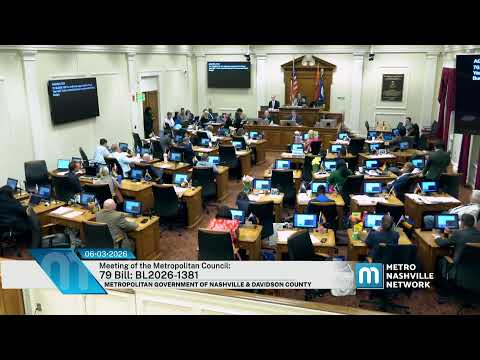
On first reading Tuesday the Metro Council introduced two companion ordinances to address AI data centers: one would add new data-center uses and associated zoning rules to Title 17; the other would restrict certain construction materials for such facilities.
Public comment dominated much of the early evening for these items. Khloe Dunigan, a 19-year-old resident from Rutherford County, told the council that large data centers can use "up to 5 million gallons of water per day" and warned of toxic industrial discharges and heavy-metal contaminants from cooling systems. "These centers are also corrosive and toxic to the air that we breathe," she said.
Kelly Ching, another public commenter, framed data centers as the backbone of mass surveillance and raised equity concerns about siting near historically Black neighborhoods: "Data centers are increasing our electric bills and taking our water and polluting our environment'we're building our own cages," she said.
Procedure and next steps: The two companion bills (BL2026-1391 and BL2026-1392) passed on first reading and can be amended on later readings; a late-filed moratorium ordinance that would have suspended permits for data-center development was presented but the council did not suspend rules to consider it immediately. Sponsors said they would work with colleagues and staff to refine regulatory language in the coming weeks.
What to watch: Council deliberations will likely focus on water-consumption limits, environmental discharge standards, sound/noise mitigation, setbacks from sensitive uses (schools, hospitals, historic neighborhoods) and transparency about corporate incentives and surveillance-related services tied to data-center operations. Community groups asked the council to ensure environmental reviews and public hearings for future proposals.