Get Full Government Meeting Transcripts, Videos, & Alerts Forever!
Get email alerts on the Comprehensive Plan topic
No spam. Unsubscribe anytime.
Mauldin staff present draft comprehensive plan to guide next decade of growth
Summary
Staff introduced a draft comprehensive plan required by the State of South Carolina every 10 years, outlining a vision that emphasizes mixed-use centers, trail and transit connections, complete-streets policies and potential annexation tiers informed by about 40 listening-session participants.
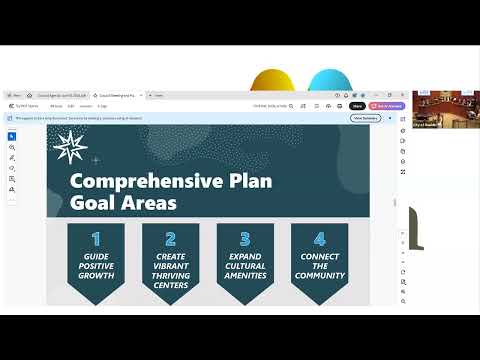
Mauldin staff presented a draft comprehensive plan required by the State of South Carolina’s decennial planning cycle and described core goals intended to guide the city’s growth over the next 10 years. The presenter said the document lays out a vision and framework, strategic goals to expand cultural amenities and connect neighborhoods, and recommended actions to encourage mixed-use development and stronger transit and trail linkages.
The presenter said staff conducted community outreach — a community survey and a series of listening sessions that the transcript records as involving roughly 40 residents — and that that input shaped three major elements of the draft: a vision statement, a goals-and-strategies framework, and implementation recommendations. The plan, the presenter said, also includes examples of incentives to encourage business investment and notes potential annexation-area tiers for future consideration.
Key recommendations described by staff include establishing growth centers or nodes to concentrate development, expanding trail and transit street networks to improve multimodal connectivity, promoting neighborhood mixed housing and compatible commercial uses, and amending city regulations to advance "complete streets" design principles. Staff also flagged new and existing cultural centers as places for targeted investment.
Council members asked for clarifications about specific map features and annexation boundaries and whether proposed centers referred to existing infrastructure or future development. Staff acknowledged those follow-ups and said more detailed mapping and technical work would be needed to finalize boundaries and incentives before adoption.
The plan’s schedule and next steps were presented as moving toward formal adoption after additional technical refinements and public-review tasks; the transcript does not record a final vote or adoption date.