Get Full Government Meeting Transcripts, Videos, & Alerts Forever!
Get email alerts on the Land Use Variance topic
No spam. Unsubscribe anytime.
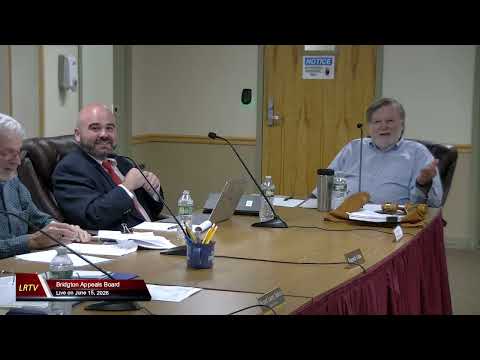
Bridgton appeals board finds variance standards met but tables final lot‑split pending survey
Summary
The Bridgton Board of Appeals voted that the six statutory variance factors were met for an owner seeking to split a US 302 parcel, but the board tabled final approval until the applicant provides a stamped survey and any additional variance requests; a continued hearing was set for Sept. 28, 2026.
The Bridgton Board of Appeals on a 5–0 series of roll‑call findings concluded that the legal standards for granting a dimensional variance were satisfied for an application to split a parcel at 534 Portland Road, but the board stopped short of recording a final approval and set a date‑certain continuance so the applicant can submit a stamped survey and any amended variance requests.
The applicant, Joe Galineri, told the board he is seeking the split as part of an “exit strategy” after turning 60, with the front parcel holding his commercial museum and shop and the back parcel remaining his residence. “I turned 60 last year. So that started me down my exit strategy of my business and my property,” Galineri said, describing the existing mixed commercial and residential uses on the roughly 2.84‑acre site.
Board members and the town’s code enforcement officer, Brenda, walked through the town’s outer‑corridor dimensional rules adopted in 2019, noting that a residential lot must be about 80,000 square feet. The parties agreed their arithmetic left the proposed back lot at about 1.83 acres (roughly 79,700–79,715 square feet), slightly under the 80,000‑square‑foot threshold and producing a shortfall compared with the combined standard across two new lots.
Counsel for the board, Brandon Mer, emphasized the procedural question the panel must first resolve: whether the application presented a threshold “practical difficulty” under the ordinance — a showing that strict application of dimensional standards would prevent an allowed use and cause significant economic injury. Members split briefly on where to begin that analysis, but the panel moved through the ordinance’s six factors and recorded its findings on each. For example, the board unanimously found the lot’s circumstances were unique to the area and that granting relief would not produce an undesirable change in neighborhood character.
Several members cautioned that the hand‑drawn map in the packet is not a substitute for a professional survey. “We need a stamped survey so that we know exactly what the acreage is in each lot,” one member said; the board repeatedly noted that small shifts in the proposed dividing line could change which dimensional requirements would be implicated.
The board discussed alternatives the applicant might pursue — including a land‑condominium structure or a private road/right‑of‑way to satisfy frontage rules — but concluded these either impose additional cost or raise legal questions beyond the board’s narrow variance review. Counsel and staff advised that while the board could make the factual findings required for a variance, the actual lot split would likely trigger additional dimensional relief (for frontage or setbacks) once the survey is complete.
On that procedural footing, the board left the factual findings on the record (several motions concluding the standards were met by roll call) but voted to table the final decision and any recording until the applicant files a stamped survey and, if necessary, amended applications for any additional variances. The board set a continued hearing for Sept. 28, 2026, and instructed staff that the applicant may return earlier if materials are ready sooner.
The Board of Appeals did not grant a final recorded variance at the meeting; rather, it recorded its findings on the six statutory factors, set conditions and asked the applicant to return with precise survey information and any additional variance requests. The board adjourned after confirming the date‑certain continuance.