Get Full Government Meeting Transcripts, Videos, & Alerts Forever!
Get email alerts on the State Policy Township Reform topic
No spam. Unsubscribe anytime.
State rep. outlines forced township consolidation process and fielded local concerns
Summary
State Rep. Alex Zimmerman told Ripley County officials that the Department of Local Government Finance will score townships under Senate Bill 270 and may require forced consolidation for high-scoring townships; trustees and fire chiefs asked about budgets, fire protection and timeline implications.
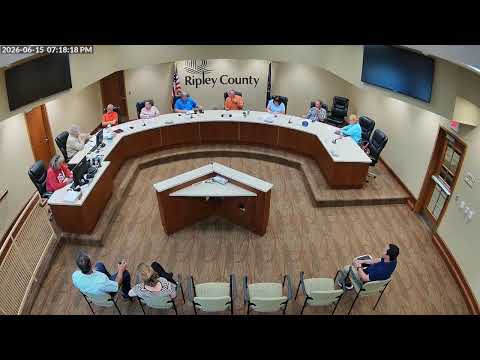
State Rep. Alex Zimmerman visited the Ripley County Council meeting to explain Senate Bill 270 and answer local questions about township consolidation.
Zimmerman said the law lays out two tracks: voluntary consolidation using existing law, and a ‘‘forced consolidation’’ track where the Department of Local Government Finance (DLGF) scores townships on up to 10 factors. He said DLGF will produce preliminary scores for all townships by Dec. 31, after which townships can request a review; if a township scores four or higher, the county should begin merger conversations with neighbors or risk forced consolidation under the statute.
"At this point it's all in the hands of the Department of Local Government Finance," Zimmerman said. "They have until December 31st of this year to get that preliminary score completed for all the townships across Indiana."
Zimmerman said many of his counties will not meet the municipal-absorption criteria in the law (which requires 80% overlapping municipal boundaries), so the likely effect will be forced consolidation through DLGF scoring rather than municipal absorption. He said that if consolidation is mandated, new governance would still include a trustee and advisory board for the merged entity, with boundaries remaining intact for levy purposes, but the governing structure consolidated.
Trustees and volunteer-fire leaders raised questions about how budgets, property ownership and fire contracts would be handled. Ben Severing, a local fire chief, asked whether consolidation would change contracts or ownership of fire-department property. Zimmerman responded that consolidation eliminates some township offices but "you're not going to lose your fire department" and that fire contracts would be handled by the receiving township/governing entity.
Several trustees expressed concern that smaller townships could be disproportionately penalized by scoring criteria that emphasize timely reporting and staffing, while large urban townships with larger staffs might fare better. Trustees asked whether scores are revisable; Zimmerman said DLGF’s scoring largely looks at recent historical data and that townships' scores are based on past practice and filings.
He urged trustees and counties to review available score calculators (including an Indiana Township Association tool) and to begin planning and collaboration with neighboring townships well before DLGF’s deadlines.
Zimmerman closed by encouraging locally led planning and said the law will likely require follow-up work in subsequent legislative sessions as the state and local governments implement the details.