Get Full Government Meeting Transcripts, Videos, & Alerts Forever!
Get email alerts on the CCR 870 Rulemaking topic
No spam. Unsubscribe anytime.
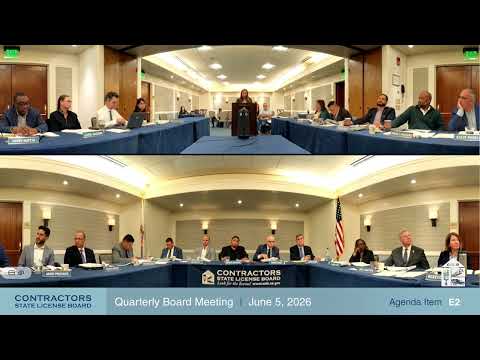
CSLB authorizes rulemaking to tighten relicensing timelines after revocation
Summary
The Contractors State License Board approved initiating rulemaking to update CCR §870, aiming to clarify factors for earliest reapplication after license revocation and to address variance in historical practice; public commenters urged the board to also address 'phoenix entities' that reenter under new license numbers.
The Contractors State License Board on Wednesday authorized staff to begin rulemaking to revise California Code of Regulations section 870, which governs the earliest date a revoked licensee may reapply.
Registrar staff told the board the current regulation dates from 1989 and yields inconsistent outcomes when applied. "Things have changed over the years and how we've applied the law," the Registrar said, describing a range of historical prohibitions (one to five years) tied to the seriousness of violations, restitution, and rehabilitation. The proposed rulemaking seeks clearer factors that balance public protection and fairness.
Several public commenters urged the board to expand the review or pursue a parallel rulemaking to close a documented loophole: principals with revoked licenses often form new corporate entities or assume new license numbers and continue operating — a problem commenters called "phoenix entities." One commenter asked that the rulemaking explicitly address whether waiting periods should also apply to new license applications when a named principal shares identity with a revoked licensee.
The board voted to submit the proposed CCR §870 text to the Department of Consumer Affairs and the Business, Consumer Services and Housing Agency for review and to authorize the Registrar to make technical or non-substantive edits prior to a 45-day public comment period. If no adverse comments or requests for hearing are received, staff is authorized to complete the rulemaking.
Board members noted that oversight of reapplications for principals with revocation histories may require a separate or expanded initiative and agreed to return to the issue in a future agenda to consider monitoring mechanisms and application screening.