Get Full Government Meeting Transcripts, Videos, & Alerts Forever!
Get email alerts on the Industrial Siting topic
No spam. Unsubscribe anytime.
Debate over industrial-siting prepayments and bonds leaves committee seeking alternative bill
Summary
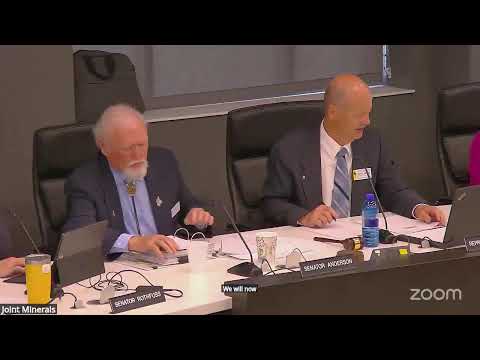
After hours of testimony from local officials, industry and agencies, the Minerals Committee declined to advance a bonding-heavy draft and directed staff to redraft an alternative (25 LSO 70) that allows prepayments without mandatory industry bonding.
The Minerals Committee spent the bulk of its Thursday session on a contentious proposal (27 LSO 21) that would authorize prepayments of industrial-siting impact-assistance awards and require permit applicants to post a bond with the Department of Environmental Quality to secure any prepayment.
LSO staff presented the draft as a tool to allow local governments to receive a portion of impact assistance before construction begins; the example in the draft set the cap at 20 percent of an award and required that any bond be submitted within 45 days of permit issuance. "That 20% figure is of course a matter for committee consideration," Brian Fuller told members.
The Department of Environmental Quality urged a set of statutory cleanups (changing repeated references to "counties, cities and towns" to the statute—term "local governments") and described how the Industrial Siting Council currently requires itemized, evidence-backed requests. Jenny Staven, the DEQ industrial-siting administrator, said a prepayment "would have to be justified by the facts presented to the council" and that the council typically expects itemized, documented evidence for large-ticket items such as fire trucks or ambulances that require long lead times.
Local officials pressed for stronger upfront support. Dave North, a county commissioner, and Mayor Warz of Mills described long lead times for specialized emergency vehicles and infrastructure, and asked for more reliable access to funds. "Mills can't continue to support the financial burden of these," Mayor Warz said, listing multiple approved impact-assistance awards the city has not yet received.
Industry and mining representatives warned that mandatory bonding requirements could make projects financially infeasible. Trade witnesses and project developers told the committee that large projects face complex, multi-year financing timelines and that posting an additional bond for 100 percent of an award would impose large annual carrying costs and could chill investment. "If you put that 100 percent bonding requirement on a project, it ties up a lot of money and could prevent financing from closing," said a mining-sector representative.
After extensive debate and public comment from mayors, county commissioners, industry lawyers and trade groups, Representative Larson moved to draft and advance an alternative working-group bill (25 LSO 70) developed in prior sessions; that earlier draft allows for prepayments but does not require industry to post mandatory bonds. The committee approved drafting 25 LSO 70; the bonding-centered draft (27 LSO 21) received no motion and did not advance.
What happens next: Staff will prepare the alternative 25 LSO 70 for the committee—to review at a subsequent meeting. The committee asked for clearer timelines on distributions and for technical fixes ("local governments" language) to avoid inadvertent gaps in statute.
Sources: Committee testimony by Brian Fuller (LSO), Jenny Staven and Nancy Ver (DEQ), testimony from county and city officials, industry witnesses, and the committee's recorded motions and votes.