Get Full Government Meeting Transcripts, Videos, & Alerts Forever!
Get email alerts on the Virtual Education topic
No spam. Unsubscribe anytime.
Virtual K–12 programs draw scrutiny on counting, funding and outcomes
Summary
Legislative staff and education officials reviewed how full-time virtual students are counted for funding and accountability, historical enrollment trends and a long-standing state grant program; virtual program leaders described services, outcomes and partnerships with home districts.
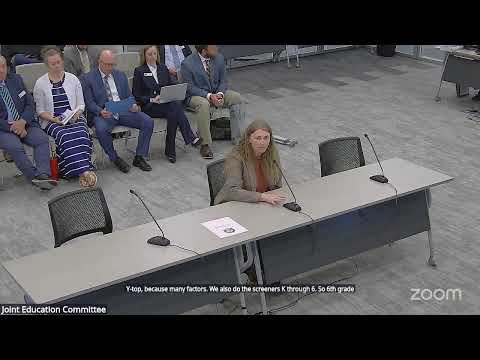
Legislators spent part of Wednesdays interim hearing on virtual education, reviewing how full-time virtual students are counted for funding and accountability, historical enrollment shifts since the pandemic and how statewide programs operate.
Legislative staff overview: Matthew Wilmarth (Legislative Service Office) explained that Wyoming law treats "virtual education programs" as district programs, not separate schools. Full-time virtual enrollment is defined as students taking more than 50% of coursework through a virtual program; those students are assigned to a brick-and-mortar school for ADM (average daily membership) and are included in assessment and accountability calculations. Enrollment spiked in 2020–21 during COVID-19, then stabilized; full-time virtual enrollment currently represents roughly 2.9% of statewide public-school enrollment.
Funding and grants: The Department of Education administers a longstanding competitive grant to help districts develop and accredit virtual programs; legislative appropriations to that line have varied across biennia. Wilmarth and staff flagged ongoing recalibration work that may revisit technology funding (computer-to-student ratios) and per-student funding levels for devices and infrastructure.
Program leaders on outcomes: Leaders from established statewide programs described staffing models (dedicated Wyoming-certified teachers, counselors and intervention staff), supports for special education and MTSS interventions, and student outcomes: graduation ceremonies, college credit attainment, industry credentials and wide geographic participation. Program representatives described benchmark assessment strategies (e.g., Renaissance), and noted that while some state assessment outcomes lag in certain grades, local growth measures and interventions frequently show substantial progress.
District relationships and extracurriculars: Virtual program directors said they coordinate with students ' home districts on athletics and vocational courses; part-time course exchanges and memoranda of understanding are common.
What’s next: The committee said it will watch recalibration work affecting technology funding and may request additional data on virtual student performance and the grantprogram's effects.
Sources: Legislative staff presentation and Department of Education memo, and testimony from Wyoming Virtual Academy, Cowboy State Virtual Academy, Wyoming Connections Academy and other program leaders at the June 17 hearing.