Get Full Government Meeting Transcripts, Videos, & Alerts Forever!
Get email alerts on the School Discipline topic
No spam. Unsubscribe anytime.
Lawmakers reopen debate on school discipline bill after extensive testimony from educators
Summary
A legislative interim committee reviewed House Bill 65, which would require districts to adopt detailed discipline policies; educators warned the bill is too broad, urged local, tiered approaches, and offered to work with a committee subgroup to rewrite problematic language.
A legislative interim committee on Wednesday revisited House Bill 65, a consolidated school-discipline bill that would require Wyoming school districts to adopt detailed policies on classroom management, parental involvement, removal of disruptive students and mandatory reporting.
The bill was outlined by Tanya Hitrich of the Legislative Service Office, who told the committee the consolidated draft arose from two earlier bills and includes explicit statutory requirements for district policies and professional-development standards. Hitrich said the draft would modify the statute governing disciplinary measures and would require districts to adopt policies by Aug. 1, 2026, and create reporting pathways from schools to the Department of Education and back to the committee.
Why it matters: Committee members and many witnesses said the bill aims to address real concerns—teachers’ safety and classroom disruptions—but described the draft as a heavy-handed, top-down approach that could create practical problems for districts, particularly smaller ones.
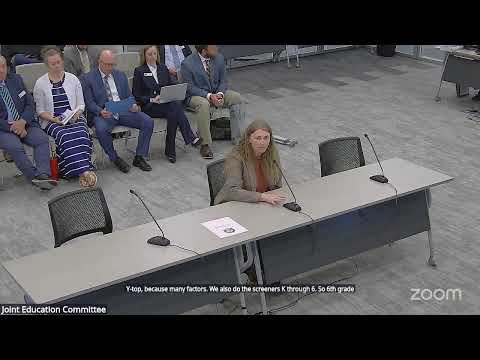
Educators, administrators and associations urged a narrower, surgical fix. Boyd Brown, executive director of the Wyoming Association of School Administrators, said smaller districts may lack space and staff to implement mandated alternative classrooms and cautioned that the bill could force costly, one-size-fits-all responses. "It really is an issue that needs to be dealt with at the local level," Brown said, adding that districts already use tiered discipline matrices and administrative regulation.
The Wyoming Education Association, represented by Tate Mullen, emphasized teacher safety but warned against provisions that could increase suspensions and expulsions and exacerbate a school-to-prison pipeline. The Wyoming School Boards Association asked the committee to first define the specific problem the bill would solve and to weigh operational impacts such as staffing and the cost of professional development.
Several superintendents and school leaders urged clearer statutory definitions if the legislature proceeds: what counts as "violent, abusive or uncontrollable" behavior, and what is "reasonable force"? Teresa Chalk, superintendent of Lincoln County School District No. 1, asked whether existing federal and state reporting (the "636 report") already captures the incidents lawmakers cited.
Opposition and compromises: Many witnesses did not oppose the bill’s intent; rather, they urged a rewrite. Common recommendations included: explicitly requiring tiered local discipline matrices before removal; clearer definitions for key terms; procedural safeguards and appeals; and stronger avenues for teachers to escalate unresolved local problems to the Department of Education.
Committee response and next steps: Committee members repeatedly returned to two themes—protecting classrooms so other students can learn, and avoiding policies that substitute state mandates for local practice. Chairwoman Schuler accepted an offer from Senator Rothus to convene a legislative subgroup to work with stakeholders and redraft the bill. The committee opened public testimony and invited education stakeholders to participate in the subgroup.
What’s next: The committee will reconvene with subgroup recommendations during the interim. Any statutory changes will be shaped by that subgroup’s work and by additional data the Department of Education provides on incident reporting and implementation costs.
Sources: Committee staff presentation and public testimony at the June 17 interim meeting, including statements from Tanya Hitrich (Legislative Service Office); Boyd Brown (Wyoming Association of School Administrators); Tate Mullen (Wyoming Education Association); Nick Bellac (Wyoming School Boards Association); and several superintendents and district leaders.