Get Full Government Meeting Transcripts, Videos, & Alerts Forever!
Get email alerts on the Land Development 180 Acres topic
No spam. Unsubscribe anytime.
Residents press Lake Elmo EDA over traffic, water and density at 180‑acre public hearing
Summary
The Lake Elmo Economic Development Authority opened a public hearing on the city’s 180‑acre site (acquired through the 2019 3M settlement). Residents voiced concerns about truck traffic, PFAS in water, and potential high‑density housing; staff outlined an RFP timeline and next engagement steps.
The Lake Elmo Economic Development Authority opened a public hearing on the sale and phased development of about 180 city‑owned acres, and residents raised traffic, water‑quality and density concerns while staff described next steps including a broker RFP and a community open house.
Community Development Director Stahlecker told the EDA that the city owns roughly 180 acres on its western edge, divided across three parcels and resulting from the 2019 settlement with 3M. She said the city intends to market and sell the site in phases — beginning with parcel one — and that ULI (Urban Land Institute) work in 2025 produced guiding principles to “maximize community benefit,” protect Lake Elmo’s character, set design standards, remain market‑responsive and integrate open space and trails.
Stahlecker said parcel one is roughly 20 acres and has an existing sewer connection, parcel two (about 50 acres) does not yet have sewer access, and parcel three is the largest and mixed‑use in concept. She told the board that a broker RFP is anticipated (staff referenced a May 2026 RFP timetable for engaging a broker to market the property) and that a community open house and additional engagement will follow.
At least a dozen written comments submitted before the meeting urged limits on density and certain commercial uses, asked for buffers and conservation areas, and raised concerns about noise, light pollution, water costs and traffic. At the meeting, residents amplified those points.
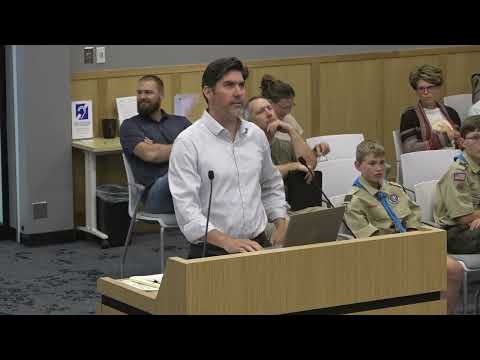
“We really didn’t want to live next to big warehouses and industrial developments,” said Andrew Wolfram, a resident living about 100 feet from parcel one who identified himself as a truck driver, warning that placing warehouses near the site would increase commercial truck traffic, worsen safety at nearby intersections and accelerate road wear.
Robert Dew, who said he supports putting city land back on the tax rolls, cautioned against rushing into workforce housing without clear parameters. “If we go down that path . . . I would highly recommend that we put some real parameters about what we as a city want that to be,” Dew said, urging the EDA to set AMI thresholds and explicit RFP guidance so proposals match the city’s long‑term goals.
Jennifer Stathman, president of the Wildflower Shores homeowners association adjacent to parcel three, asked that watershed protections and county water‑quality reviews be factored into parcel‑three decisions and that buffers reflect the neighborhood’s protected watershed status.
Other speakers asked for revenue projections and clarity on how sale proceeds would be used. Resident Lucian Justin said he had not seen financial forecasts and asked for projected tax‑revenue estimates that would justify the sale.
Some residents voiced worry about the city’s water supply and PFAS. One attendee sought detail on whether the city’s water is being filtered and whether the system can support additional development. Staff responded that the city’s water currently meets legal health standards, that a filtration unit is operating on well number two, and that the city is pursuing a southern filtration plant with 3M settlement funds; staff also said traffic studies will be required for any large development proposal and that developers commonly bear costs for required intersection or roadway improvements.
The EDA emphasized that specific uses and developers are not yet selected: staff said the market will influence proposals, and that the city’s public engagement (including a survey that closes July 3 and an open house June 30) will inform what guidance is included in the broker RFP and future development agreements. Stahlecker and other staff said they will compile public questions and answers and plan to publish responses and a summary report back to the council after the open house and community engagement.