Get Full Government Meeting Transcripts, Videos, & Alerts Forever!
Get email alerts on the Plan Update topic
No spam. Unsubscribe anytime.
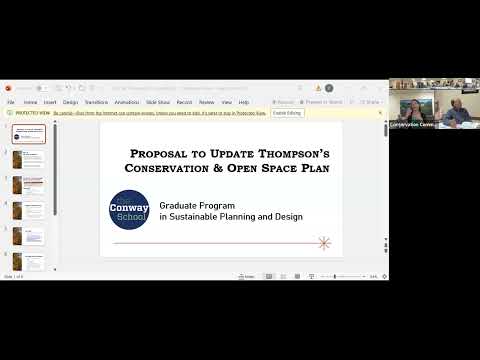
Conway School offers 12‑week student project to update Thompson’s conservation and open‑space plan
Summary
The commission heard from Emily Johnson of the Conway School, which proposed a 12‑week, student-led update of Thompson’s conservation and open‑space plan that would include GIS mapping, stakeholder engagement and recommendations; typical community cost is $10,000–$15,000, with the school subsidizing the remainder of its $26,000 cost-recovery figure.
Emily Johnson, projects manager at the Conway School of Sustainable Planning and Landscape Design, on June 15 proposed a 12‑week student-led project to update Thompson’s plan of conservation and open space, emphasizing GIS mapping, community engagement and decision-support tools.
Johnson told the Conservation Commission the Conway School projects run in an accelerated winter term: students work on a community scope developed with a local core team, do a 12‑week analysis and present a draft in March with final deliverables in April. "The cost of recovery to the Conway School is $26,000," she said, adding that communities commonly pay "$10 to $15,000" while the school subsidizes the balance for educational value.
Why it matters: Thompson’s conservation and open-space material is out of date in places; Johnson noted the town’s 2005 conservation/open-space inventory is more than 20 years old, and that state programs typically look for reasonably current planning documents when awarding competitive grants. The commission also heard that the plan-of-conservation-and-development requirement is governed by state statute and that a current plan improves the town’s grant competitiveness and planning accuracy.
Johnson described the project’s technical components: a GIS inventory of protected open space and recreational assets, ground‑truthing with local volunteers, a public survey or stakeholder forums designed with the town’s core team, and options that range from a prioritization tool to parcel‑specific recommendations. "Stakeholder engagement is a really big part of the Conway School process," she said. The school also factors climate resilience—focusing on stormwater, culvert and flood‑risk issues—into its recommendations.
Commission members and residents pressed practical questions about who counts as the "community," whether meetings should be public, and how students would acquaint themselves with local conditions during a winter term. Johnson said the town’s chosen core team (three to five local representatives) would help identify key stakeholders and run site tours; she said students typically make one to two in‑person visits and rely heavily on desktop analysis and local volunteers to provide on‑the‑ground context.
On funding, Johnson said the Conway School evaluates proposals partly on educational fit when communities cannot cover full cost. She and commission members said Connecticut currently offers fewer planning grants that match Massachusetts technical‑assistance programs and that the town should consider a mix of in‑house volunteers, regional services and outside contractors if needed.
Next step: The commission placed the proposal in "old business" to continue discussing scope and funding at its July meeting. Members noted possible funding options (including fee‑in‑lieu open‑space balances) and asked staff to bring budget figures and grant research to the next discussion.
The Conway School provided to the commission a recording and slides and offered to supply examples of past projects on request.