Get Full Government Meeting Transcripts, Videos, & Alerts Forever!
Get email alerts on the Service Garage Purchase topic
No spam. Unsubscribe anytime.
Fairview Park finance committee reviews Mastic Road purchase for city service garage amid questions on wetlands, noise and costs
Summary
The finance committee reviewed studies for a proposed purchase of the Mastic Road parcel and a phased plan for a new service garage funded in part by $1 million in county ARPA funds; staff said land purchase is funded but construction will be phased, while council and residents pressed for more detail on wetlands, mitigation costs, noise and timelines. The committee extended the purchase contingency and left the ordinance in committee.
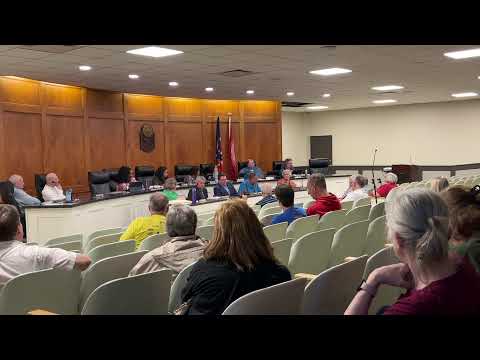
Council members and city staff on Monday reviewed technical studies and budget implications for a proposed purchase of a parcel on Mastic Road that city leaders say could become a new service garage.
Assistant Development Director Megan Otter opened the presentation by saying the city commissioned six studies to vet the 2.6‑acre parcel and that a $1 million ARPA allocation from the county is available to secure the land. Consultants summarized environmental, geotechnical, traffic and wetland work and answered repeated council questions about mitigation, phasing and cost estimates.
Why it matters: city officials said the existing service garage lacks adequate employee facilities and is impeding recruitment and operations. The proposed purchase would secure an off‑campus site where the city could phase in locker rooms, vehicle storage and other service‑department needs; opponents and some residents warned the site’s low‑quality wetlands, noise environment and proximity to residents require closer review.
Consultants’ findings and what council asked
Kim Kerber, a consulting engineer with the firm listed in the packet, reported the Phase I environmental site assessment found no recognized environmental conditions on the parcel and that geotechnical borings to 20 feet indicate the site is buildable with limited localized soil stabilization. “This study did not find any items of concern on the existing parcel,” Kerber said.
Kerber also summarized a prior ODOT noise analysis that showed hourly average decibel levels along I‑480 in the vicinity commonly in the mid‑60s to mid‑70s dBA, with some readings above roughly 67 dBA. She told council that because service‑yard operations are intermittent (trucks arrive and leave), staff do not expect continuous new noise above current highway levels but acknowledged the study relied on hourly averages rather than short‑duration peak events.
Traffic consultants from American StructurePoint said the full build of the service garage would generate an estimated 60 peak‑hour trips (30 entering and 30 exiting in a peak hour) and that studied intersections would not require turn lanes or show service‑level declines under current assumptions. “We estimated 60 peak hour trips,” Ben Morgan of American StructurePoint said, summarizing the trip generation used in the study.
Wetlands and permitting
Wetland delineation identified three Category‑1 wetlands totaling about 0.158 acres — under 6% of the parcel but above the 0.1‑acre threshold that typically requires compensatory mitigation credits if disturbed. Kerber told council that disturbing less than a tenth of an acre generally avoids mitigation payments, but disturbing more would likely require mitigation, permitting and possibly an Army Corps jurisdictional determination and Section 401/404 permitting. Consultants said mitigation bank credits are currently priced in the tens of thousands per acre and provided an order‑of‑magnitude estimate: roughly $68,000–$70,000 per acre and roughly $7,000–$15,000 for a tenth of an acre as a planning reference.
Funding and timing
Finance Director Jennifer Pay told council that the money currently before council is for land purchase and that the city lacks capacity to construct a full garage in 6–12 months. “What is before council is the opportunity to purchase the land,” Pay said. She described a multi‑year, phased approach: modest interior improvements first (locker rooms, showers) and later site development once funding options — grants, debt or other sources — are secured.
Council members pressed the administration on several procedural concerns: when outside consultants and advisors were engaged, whether school‑district partnership options were adequately pursued (the city said an earlier mutual plan with schools did not proceed), and whether consultant relationships risk creating the appearance of conflicts of interest. A member of the public raised that concern directly; Kerber and others defended the ethics and described the rapid timeline for the city’s requests.
Actions taken
Council moved to amend Ordinance 2618 to add Addendum B and extend the contingency date for the purchase to May 18; the committee approved the amendment by recorded voice votes. The committee then voted to leave Ordinance 2618 in committee for further consideration. The votes were recorded as unanimous among present members.
What remains unresolved
Council and members of the public asked for clearer documentation on: the precise parcel acreage and ownership details reported in the studies; whether EPA/Army Corps jurisdictional determinations will be required and on what timeline; more granular noise monitoring during typical service‑yard operations; and updated cost estimates that include remediation, wetland mitigation (if required), equipment and potential off‑site work such as a salt dome or fuel station. Officials said additional technical review and design‑stage testing would follow if council proceeds with purchase.
Next steps
The ordinance remains in committee; staff said the city has the ARPA dollars set aside for purchase and is proceeding with due diligence, permitting steps and further design work in phases. Council members and public commenters urged parallel investigation of alternative or bifurcated options (for example splitting functions between sites) as the committee continues deliberations.
Council vote
On the amendment to extend the contingency the committee recorded unanimous yes votes for the amendment and then unanimously voted to keep the ordinance in committee; recorded votes were announced by the clerk during the meeting.
(Reporting by Fairview Park meeting transcript; technical studies cited were presented to council.)