Get Full Government Meeting Transcripts, Videos, & Alerts Forever!
Get email alerts on the Land Development topic
No spam. Unsubscribe anytime.
Commissioners provisionally approve Legacy Grand Ranch plat and bond, flag railroad and engineering contingencies
Summary
Walker County commissioners approved plans and a roughly $10.05 million performance bond for the Legacy Grand Ranch subdivision contingent on satisfying several engineering comments, securing railroad concurrence for a roadway tie-in and providing procurement documentation required for federal reimbursement.
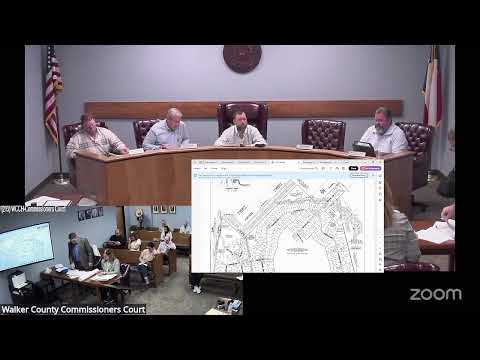
Walker County Commissioners Court gave contingent approval June 15 to the Legacy Grand Ranch subdivision plans and to a performance bond for the project, while outlining several engineering and permitting conditions the developer must satisfy before substantial completion and bond release.
The court accepted plans for filing and approved a performance bond after county engineers and the developer’s consultants spent more than an hour reviewing drainage, slope and right-of-way issues. County engineering flagged unresolved items including whether a recently approved variance covers an entire culvert crossing or only a portion, multiple culvert lengths that may need to change to meet a 6:1 front slope requirement outside approved variances, and a small area of additional paving that will require railroad concurrence at an existing permitted crossing.
“One reason we’re here today…is to try to get to an end goal at least to see an end goal to find out where we need to go,” said Jacob Slot, a representative for the developer, urging the court to define what remains so the project can move forward.
County planner/engineer Stephanie (BL Engineering) summarized detailed technical comments and asked that specific items be corrected or clarified in the final construction plans. She identified six culvert locations where slopes and headwall details need confirmation, and listed areas where concrete slope paving must be added if hydraulic velocity calculations exceed the five-feet-per-second threshold set by county standards.
Angie Sanchez, one of the project engineers, told the court the design team had checked hydraulic velocities and could provide calculations: “We did check the velocity…so where Stephanie’s talking about putting slope paving, we did check to make sure the velocities didn’t exceed the limit where we would actually need concrete slope paving. So if there’s a concern, we can provide the information for that.”
A point of particular concern was a small portion of proposed paving that encroaches into the railroad right-of-way for a permitted crossing. Staff advised the developer to obtain written railroad concurrence or to redesign the tie-in so recording the plat is not delayed while the railroad review proceeds. The court and developer discussed allowing the plat to be recorded while holding specific lots or roadway segments in reserve, rather than delaying the entire subdivision filing for the railroad response.
The court also required procurement documentation for several federally funded road engineering items before authorizing expenditures that will be reimbursed. Grants staff requested solicitation and contract records (or a sole-source justification) be gathered and retained so federal reimbursements can be claimed.
Bond and quantities: County engineering and the developer’s team disagreed on quantities for some items, most notably concrete slope paving. Engineering’s cost estimate placed greater quantities and a higher bond amount than the developer’s latest submission. County staff recommended accepting the bond as presented and revisiting the estimate in 30 days if construction progress reduced the work remaining.
The commissioners approved the plans for filing and the performance bond with specific conditions: BL Engineering’s comment letter (dated 6/12/26) must be satisfied prior to filing except for comments 7, 8, 13 and 14, which must be resolved before bond release and substantial completion. The court recorded the motion and carried it by voice vote.
What’s next: The developer must provide the clarified engineering documentation, any required railroad concurrence or an acceptable redesign of the tie-in, and the procurement/contracting records needed for federal grant reimbursement. The court will require those items before certifying the project’s substantial completion and releasing bond funds.