Get Full Government Meeting Transcripts, Videos, & Alerts Forever!
Get email alerts on the Transportation Infrastructure topic
No spam. Unsubscribe anytime.
Billings council reviews 21st Street underpass study, told forwarding plan won’t commit city to construction
Summary
City staff and consultants presented a year‑and‑a‑half MPO‑funded feasibility study of the 21st Street underpass that outlines four alternatives — from no‑build to full replacement — and recommends next steps for grant eligibility; council discussion focused on safety, cost and whether forwarding the plan would create project pressure.
A year‑and‑a‑half study of the 21st Street underpass was presented to the Billings City Council on June 15, with staff and consultants recommending the council forward the study to the regional Policy Coordinating Committee so the city would be eligible for future grant opportunities.
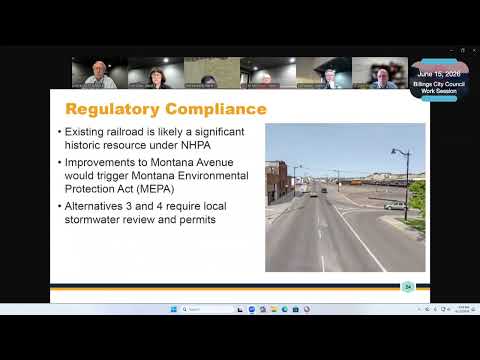
The presentation, delivered by a project planner with the MPO, said the study’s purpose was “to identify strategies to enhance safety, improve multimodal accessibility, and improve roadway conditions.” The draft study examined four alternatives: no‑build; minor improvements including an over‑height warning system and better lighting; lowering the roadway 3–4 feet to achieve roughly 11½ feet of clearance (estimated $8–10 million); and replacing the structure and lowering the roadway 5–6 feet to reach 13½ feet (estimated $26–30 million).
The consultant team reported current constraints: the underpass has an approximately 8‑foot clearance, vehicle volumes under 1,000 vehicles per day, and crash data that shows about four crashes per year (mostly property‑damage). Fire, EMS and transit cannot currently use the underpass because they require greater clearance (the presentation cited 13½ feet for fire apparatus and 10 feet for EMS). The site is close to groundwater — lowering the roadway would likely require pumping — and BNSF Railway owns the bridge, meaning any work would need railroad coordination.
Public engagement produced two rounds of survey responses (446 and 429 respondents). Respondents ranked the minor‑improvement option with intelligent transportation systems — including over‑height sensors and warning signage — as their first choice and the full replacement and raising‑to‑13½‑feet option as the least preferred. Staff emphasized that forwarding a recommendation of plan approval would not commit the city to any specific construction action, but would preserve eligibility for grant programs should funds become available.
Council discussion ranged from skepticism about local benefit and past, costly studies to concern about life‑saving time for ambulances if trains block other crossings. “We’re not asking you to commit right now to a large project,” the presenter said, adding the study is intended to position the city for future grants and to provide information should railroad or funding conditions change.
Next steps: staff said they will seek a council recommendation at the June 22 regular meeting to forward the study to the Policy Coordinating Committee, which is scheduled to take final action July 21. No formal vote on a construction alternative was taken at the June 15 work session.