Get Full Government Meeting Transcripts, Videos, & Alerts Forever!
Get email alerts on the Reparatory Justice topic
No spam. Unsubscribe anytime.
Reparatory Justice Commission releases 62‑recommendation report, urges apology and permanent oversight
Summary
The Reparatory Justice Commission presented a final report to the South Bend Common Council with 62 recommendations across housing, education, health, policing and economic opportunity; commissioners urged a city apology, preservation of the report as a public record, and a permanent oversight body to track implementation.
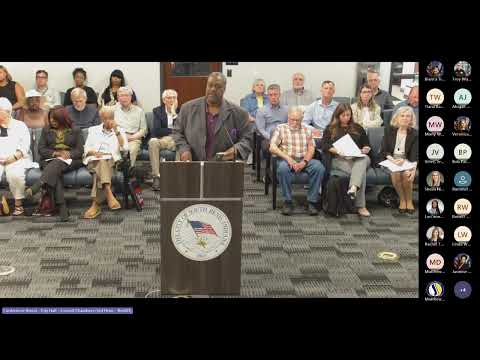
Trina Robinson, chair of the Reparatory Justice Commission, presented the commission’s final report to the South Bend Common Council, saying the group developed 62 recommendations organized by subcommittee and urged the city to formally acknowledge past harms and create a permanent oversight committee to monitor progress.
Robinson told the council a QR code linked to the report and invited residents to a fuller presentation on June 29 at 6:00 p.m. at the library. “The city of South Bend can take these specific steps toward racial reconciliation,” Robinson said, adding that the commission’s recommendations are intended to create lasting structural change rather than a one‑time payment.
The report is organized by five areas: economic opportunity and employment; housing; education; health and mental health; and policing and criminal legal systems. Economic subcommittee chair Jame James Lewis detailed long‑running employment and contracting disparities, saying Black workers were often segregated into the lowest‑paid, most dangerous factory jobs historically and that Black‑owned businesses received very few city contracts. He recommended youth wealth‑building programs, preferential contracting for smaller purchases, banning some credit or criminal history screens in city hiring, and enforcement of developer commitments where tax incentives or abatements are awarded.
Housing chair Judy Fox described an extensive record of racial covenants, redlining and urban renewal projects that she said drove Black residential segregation and disinvestment in neighborhoods such as Beck’s Lake and the Birdsell area. Fox said her team found 68 plats with racial covenants in deeds and that some plats with restrictive language were recorded after 1948; the subcommittee urged zoning review, preservation of records, targeted investment in historically disinvested neighborhoods and stronger enforcement when developers fail to meet job commitments tied to public incentives.
Education subcommittee members documented disparities in discipline and academic placement. Commissioners cited data showing Black students represented roughly 36% of district enrollment but accounted for about 65% of out‑of‑school suspensions and 47% of special education placements; the panel urged the district to address discipline disparities, expand preschool and afterschool programming, and improve teacher preparation in culturally responsive practices.
Health and mental health chair Cassie White connected historical housing and economic harms to persistent health inequities, including heart disease and infant mortality. White said Black infant mortality in St. Joseph County is roughly three times the rate of other groups and cited a review finding that 59% of Black infant deaths from 2018–2022 were preventable. The health recommendations include increasing community health workers, targeted lead remediation in high‑risk zip codes, and annual public reporting on health disparities.
The policing subcommittee reported preliminary findings—arrest disparities, use‑of‑force practices, pretrial incarceration and bail affordability among areas requiring deeper analysis—and said the group would continue research before issuing a final policing chapter.
Public comment during and after the presentation overwhelmingly supported the report. Nilasha Kushing of the South Bend Reparations Working Group and other residents urged the council to adopt and fund the recommendations, create the oversight committee the report calls for, and issue a formal apology and acknowledgment of harms. Several speakers requested that the city commit resources in the current budget cycle toward early actions such as lead remediation and homeowner assistance.
Council members from across districts thanked the commission for the research and personal testimony. Council member Dr. Davis said he planned to forward a formal apology to the council the next day. Multiple members stressed the need for measurable implementation, timebound steps (the commission said recommendations were categorized into immediate, three‑month, six‑month, one‑year and longer timelines), and cross‑agency collaboration with the mayor’s office, the school corporation and county partners.
The commission emphasized that its focus was “reparatory justice”—structural remedies designed for long‑term change—rather than only individual cash payments. Commissioners pointed to precedents in other municipalities that combined policy changes with housing and small‑business investments as partial models.
The commission’s full report and supporting documentation were made available to the public; Robinson said the group expects to continue oversight functions and urged the council to preserve the report as a permanent, searchable public record.