Get Full Government Meeting Transcripts, Videos, & Alerts Forever!
Get email alerts on the Climate Emissions Inventory topic
No spam. Unsubscribe anytime.
Dubuque reviews 2025 greenhouse gas inventory and discusses a science-based emissions target
Summary
Consultants told the Dubuque City Council that 2025 community emissions totaled about 680,236 metric tons CO2e, down substantially from prior baselines. They recommended the city consider adopting a science-based target (an estimated 62.4% reduction from 2018 by 2030); council members pressed for practical, municipal actions amid limited state and federal incentives.
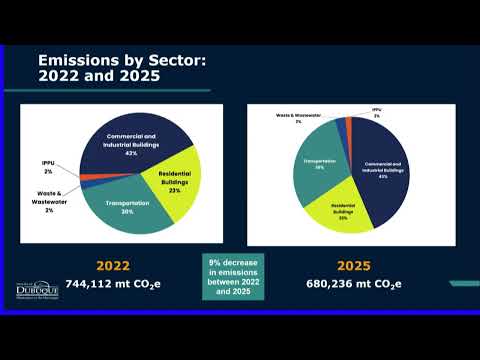
DUBUQUE, Iowa — Consultants from Lotus Engineering reported that Dubuque's 2025 community greenhouse gas emissions totaled about 680,236 metric tons of carbon dioxide equivalent (CO2e), and presented an analysis showing long-term declines driven in part by changes in the local electricity mix and increased electric-vehicle adoption.
Emma, a Lotus Engineering consultant, told the council that Scope 1 emissions (local building energy, in-boundary transportation and in-boundary waste) accounted for roughly 69% of the total, Scope 2 (electricity) about 29% and Scope 3 (transboundary aviation and transmission/distribution losses) about 2%. By sector, commercial and industrial buildings made up the largest share (about 44%), transportation about 29% and residential buildings about 22%.
The inventory shows comparable-source emissions have fallen by about 43% since 2018 and total emissions by about 39% since 2003. Rachel Meyer of Lotus Engineering said part of the recent decline reflects a reduced emission factor for the local utility, Alliant Energy, as the utility expands renewable generation; consultants also credited landfill and wastewater methane collection and an almost 200% increase in battery electric vehicles between inventories for recent improvements.
Consultants explained methodology changes since 2022: Alliant provided rooftop solar generation and a grid-specific transmission and distribution loss rate for inclusion in the model; the team also split plug-in hybrids and full battery electric vehicles in the accounting. They said changes in international guidance — from the Intergovernmental Panel on Climate Change (IPCC) — affected the global warming potentials used to convert methane and nitrous oxide to CO2e. The team used state Department of Transportation vehicle-miles-traveled data because a Google-based source was unavailable for 2025.
On a policy question, Rachel described a science-based target framework the consultants applied. "Using the One Planet City Challenge methodology, the estimated science-based target for Dubuque is a 62.4% decrease in emissions from 2018 totals by 2030," she said, noting the target is ambitious and sensitive to federal and state incentives. The consultants reported the 2018 Scope 1 and 2 baseline as about 819,408 metric tons CO2e and said reaching the 2030 science-based target would imply roughly 308,000 metric tons CO2e in 2030.
City staff and consultants outlined current local programs that reduce emissions and build capacity: the Energy Savers program (high-efficiency furnaces and water heaters for qualifying residents), the Youth Climate Action Fund (about $85,000 awarded in 19 microgrants), the Direct Pay Provision program, $427,000 secured for airport solar and EV chargers, and Branching Out Dubuque, a Parks and Rec tree-planting initiative with a 5,280-tree goal. Two municipal solar projects are in feasibility study phases and the city uses Energy Star Portfolio Manager to track municipal building energy use.
Council members pressed staff and consultants on what the city can do without robust state or federal incentives, asking for pragmatic steps the city can control. A council member asked whether peer cities had comparably aggressive action plans; Rachel said most peer cities did have climate action plans but targets and approaches vary. Council member Resnick emphasized achieving the city's adopted 50% reduction goal by 2030 and urged building community excitement through tangible accomplishments.
Staff and consultants recommended a focus on municipal operations (fleet and buildings), building-energy inventories to prepare shovel-ready projects for future funding, incremental policy updates (for example, energy codes), continued outreach and education, and identifying sustainable local funding sources. Gina Bell, the city's Director of Sustainability, said any proposal to adopt a science-based target would include community engagement and be brought to the council for decision.
The work session closed with council members expressing support for continuing existing programs, pursuing building inventories and positioning Dubuque to apply quickly for outside funding when it becomes available. Mayor Cavanagh adjourned the session.