Get Full Government Meeting Transcripts, Videos, & Alerts Forever!
Get email alerts on the Telecommunications topic
No spam. Unsubscribe anytime.
West Fork residents oppose proposed Verizon tower on city land; council weighs coverage, safety and alternatives
Summary
Council heard a Verizon representative detail a proposed 150-foot monopole to fill a downtown coverage gap; residents raised health, school proximity, aesthetics and property-value concerns while first responders urged better radio/cell coverage. Council emphasized it must evaluate the specific lease for the city parcel.
A Verizon representative told the West Fork City Council on Thursday that the company is proposing a 150-foot monopole on city-owned land downtown to close a hole in coverage and improve service for customers and first responders.
Brandt Rackcliffe, representing Verizon and Berkeley Bridge Towers, said the location optimizes coverage for downtown and that the monopole would be painted in graduated colors to blend with trees and sky. "This tower doesn't have any guide wires. It's freestanding," Rackcliffe said, adding that at 150 feet the structure would not require FAA lighting.
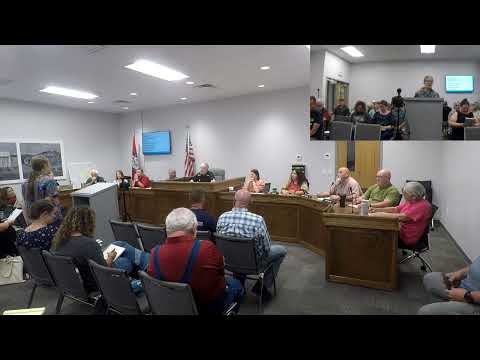
Council members and dozens of residents followed with questions and extended public comment focused on three issues: site selection and alternatives, potential health effects and aesthetics, and public-safety communications.
Many residents said the proposed site is too close to the elementary school and downtown memorial, and said a tall monopole would be an "eyesore." Sharon Davidson, who identified herself as a resident on 290 Phillips, told the council the tower "should not go downtown for the city of West Fork, for the citizens, for the children." Several speakers said property values could suffer if the tower were sited adjacent to downtown.
Opponents also raised health concerns. Rackcliffe cited material from the American Cancer Society while answering questions about radio-frequency exposure, saying that cell towers operate at non-ionizing frequencies and noting that placing towers more densely can reduce handset emissions because phones do not have to transmit as strongly.
At the same time, first responders and at least one resident who identified himself as a West Fork first responder said coverage gaps affect radios and cell calls. "My radio doesn't work. My cell phone doesn't work because I am on Verizon," a first responder named Brad said, explaining that poor signal can hamper response and force dispatch to send multiple units.
Councilors pressed Rackcliffe about alternatives and whether Verizon would consider other city parcels or negotiated compensation. Rackcliffe said engineers had reviewed several nearby sites and that moving the tower "a mile, two miles out of the way" could undermine the coverage objective, but he also said Verizon would negotiate terms and that the lease includes an 80-by-80-foot footprint and a proposed 5% rent on monthly revenue.
Several residents proposed smaller "small cell" equipment on utility poles as a less-visible alternative, but Rackcliffe and other speakers said small cells require many more nodes and are less practical for the coverage objectives described.
The council emphasized its role: to evaluate the proposed lease and location on the city parcel before it, not to research and propose other sites on Verizon's behalf. Council members also noted that federal law constrains how local governments may regulate wireless facilities on health grounds; a councilor referenced the 1996 Telecommunications Act, advising the public that health and environmental concerns are limited in local land-use decision-making.
No formal vote on the tower lease was taken at Thursday's meeting. The mayor and council said they would take the comments under advisement and continue reviewing the proposal and contract terms, including possible city access to mount public-safety antennas on any future structure and negotiation of compensation.
The council heard many voices for and against the lease; the record of the meeting shows continued public engagement and that any final decision will follow additional review and formal action at a future meeting.