Get Full Government Meeting Transcripts, Videos, & Alerts Forever!
Get email alerts on the Unified Development Code topic
No spam. Unsubscribe anytime.
Planning commission recommends repeal of old code and adoption of consolidated Unified Development Code
Summary
The Asylum Springs Planning Commission unanimously recommended repealing six existing municipal code chapters and forwarding a consolidated Unified Development Code (Chapter 35) to the board for consideration on Oct. 7, 2025; staff said Version 4.0 reflects 134 public comments and would take effect mid-December if adopted.
The Asylum Springs Planning Commission voted unanimously Sept. 9 to recommend repeal of municipal code chapters 53, 54, 78, 81, 87 and 102 and to forward a new consolidated Unified Development Code (Chapter 35) to the board of directors for consideration on Oct. 7, 2025.
Senior planner Ben Rhodess presented the proposal, calling the UDC “a collection of codes streamlined to be in one chapter of the code book” and saying the update modernizes regulations identified in the city’s 2040 comprehensive plan. Rhodess told commissioners staff logged 134 public comments and that, if the board approves the ordinance on the announced schedule, the third reading would fall Nov. 4 and the ordinance would take effect by mid-December, with most planning applications governed by the new code beginning in January 2026.
Rhodes highlighted numerous substantive changes the commission reviewed: revised planning commission rules and annual-report timing, neighborhood meeting procedures, an appeals window allowing the board to recall or appeal planning commission approvals within 10 days, updated landscaping standards using DBH (diameter at breast height) and tree-replacement fees, a reworked sign code revised to comply with U.S. Supreme Court content-neutrality requirements, new street-design standards incorporated into the code (including bicycle and pedestrian accommodations and street-tree spacing), and zoning changes such as a new R5 zone for townhomes, a UPD zone replacing the former planned-development zone, and allowing accessory dwelling units by right in single-family zones to conform with recent state law.
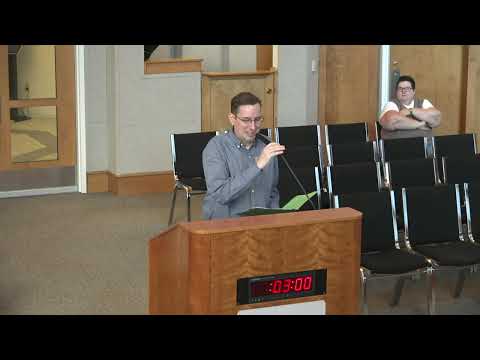
A member of the public who identified himself as “Ronire, civil engineering” urged clearer, high-resolution street-section figures in the posted ordinance and asked the commission to reconsider residential lot-coverage limits so accessory dwelling units (ADUs) are feasible on smaller lots. Rhodess replied that staff had reviewed those comments but recommended not increasing lot-coverage limits at this time because higher coverage could encourage builders to maximize footprints on small lots; he noted a variance option remains available for applicants who need relief.
Commissioners made two separate motions — one recommending repeal of the listed chapters and a second recommending adoption of Chapter 35 as presented. Both motions carried on unanimous roll-call votes. The repeal and adoption recommendations are scheduled for the board meeting on Oct. 7, 2025.
The commission also tabled a separate significant development permit (SD25-08) to Oct. 14, 2025, while staff gathers outstanding information; that item is not part of the Chapter 35 recommendation.