Get Full Government Meeting Transcripts, Videos, & Alerts Forever!
Get email alerts on the Behavioral Health And Public Safety topic
No spam. Unsubscribe anytime.
Spokane County task force urges permanent coordinating council, shared data and expanded crisis-response to link public safety and behavioral health
Summary
A nine‑month Safe & Healthy task force presented 54 recommendations to Spokane County commissioners, calling for a permanent cross-jurisdiction coordinating council, shared data systems, warm handoffs and facility investments to reduce cycling through jails and ERs and improve community health.
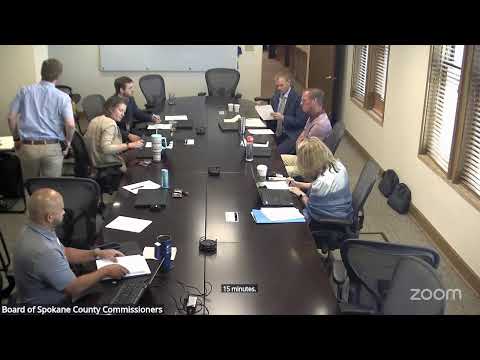
The Safe & Healthy task force told the Spokane County Board of County Commissioners on June 16 that public safety and community health must be treated together and that a permanent, cross-sector coordinating body is the first priority for implementing its recommendations. Emily Cameron, a convener of the task force, said the group’s work was driven by the idea that “public safety and community health are interdependent.”
The task force — which members say involved more than 40 core participants and 120 advisory contributors from health, housing, courts, law enforcement, philanthropy and people with lived experience — released a report last week with recommendations grouped around governance, data and coordination, programmatic changes, workforce and facilities. Lance Beck, a lead convenor, said the group’s top recommendation (A1) is “establishing a cross-sector implementation and accountability coordinating council” to drive and measure implementation across jurisdictions.
Why it matters: Task-force presenters described repeated cases where people are released from custody or encounter emergency services without a reliable handoff to treatment or housing supports — a pattern they said increases repeat contacts with jails, emergency rooms and crisis teams. Presenters flagged concrete shortfalls such as inconsistent intake and assessment tools, after‑hours release gaps that leave people without immediate access to services, and siloed programs that are not consistently coordinated across jurisdictions.
Key recommendations and priorities include: creating a permanent coordinating council with public, tribal and private partners and modest administrative funding; building shared data and accountability systems; formalizing warm handoffs and peer/lived‑experience roles across entry points; scaling mobile and alternative crisis‑response models; expanding diversion and targeted interventions for high‑utilizers; and pairing facility modernization with community treatment and housing investments.
Commissioners and task‑force conveners discussed practical next steps, including continuing planning‑team meetings through the summer and convening listening sessions and briefings for other jurisdictions. Commissioners noted that the task force did not itself design a ballot measure; conveners said the report was designed to inform any future funding proposal and that timing (for example, a November ballot) would be a decision for the Board.
Exchanges and disputes: Commissioners probed several implementation and process questions, including whether leasing an adjacent parks administrative building to stadium partners requires a separate public hearing; staff said the current replacement agreement treats the building as part of the stadium premises and relies on prior comparables and the 2023 agreement for compliance, a position some commissioners questioned as “skipping a step.” The task force and conveners acknowledged unresolved details around funding and stressed that accurate data and costing will be required before any funding request is finalized.
What’s next: Presenters recommended immediate actions that can move forward without large new appropriations (data sharing pilots, formalizing warm handoffs, scaling existing pilots) while the county and partners develop cost estimates and facility analyses. The planning team committed to continue meeting and to brief other jurisdictions; conveners offered private‑sector support for administrative functions while a long‑term structure is established.