Get Full Government Meeting Transcripts, Videos, & Alerts Forever!
Get email alerts on the K 12 Education topic
No spam. Unsubscribe anytime.
San Marino Unified board sets four goals for 2026–27, emphasizing safety, fiscal stability and future readiness
Summary
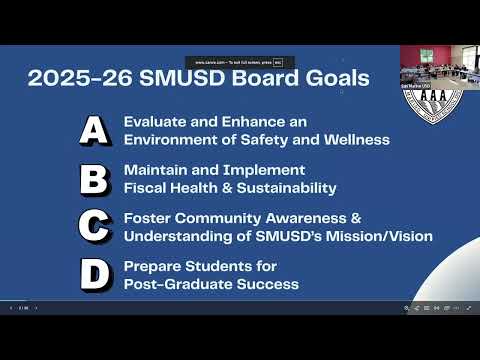
At a June 9 special strategic planning session, the San Marino Unified School District board refined four broad goals for 2026–27 — safety and wellness; strategic fiscal sustainability and future investments; enhanced community partnerships; and advancing student achievement and future readiness — and asked staff to return with measurable action plans.
The San Marino Unified School District Board of Education on June 9 laid out four refined strategic goals for the 2026–27 school year, focusing on school safety and student wellness; long-range fiscal sustainability and targeted investments; deeper community partnerships; and preparing students for post‑graduate success. Dr. Deator, a member of the district executive team who led the session, said the board would use the goals to guide site- and department-level action plans to be developed before the new school year.
The board’s planning session followed a day of stakeholder input. "We are going to delve into the board’s establishment of four important broad‑based goals for the 26–27 school year," Dr. Deator said, opening the meeting and summarizing the district’s intent to make the goals measurable and actionable. Board President Gil and other trustees spent the morning refining language and pressing staff for clear metrics and timelines.
Why it matters: Board members said the goals will shape spending, facilities projects tied to Measure M and program priorities next year. Dr. Deator warned that state funding is volatile and noted the district’s funding mix: about 70% of revenue comes from the Local Control Funding Formula and roughly 30% from two parcel taxes and local fundraising — a structure the district will have to manage carefully if state allocations shift.
Key decisions and direction - Safety and wellness: The board agreed to reframe the goal as ensuring "safe, secure and supportive learning environments that promote student wellness and belonging." Trustees emphasized that safety must be a districtwide responsibility — not solely a principal’s duty — and asked staff to create staff‑awareness surveys, track student visits to wellness centers and monitor absenteeism as a potential mental‑health indicator. President Gil summarized the board’s view: "All employees need to be responsible for safety," and the district should define roles and training so everyone knows how to act.
- AI, cameras and digital safety: Trustees discussed using technology — including AI‑driven alerts and expanded camera coverage — to help identify students who may need support, but several members urged caution. Concerns focused on privacy, community optics and the need for carefully framed pilot programs. The board also directed staff to align Measure M facilities projects with safety features and to reassess camera placement and cybersecurity as building projects alter sightlines.
- Fiscal sustainability and future investments: The board adopted language to emphasize strategic fiscal sustainability and long‑range investment priorities, including enrollment stabilization, workforce recruitment, technology readiness and program innovation, such as career and technical education (CTE). Staff reminded members of committed reserve categories identified at a prior session (e.g., enrollment stabilization, capital facilities, instructional materials) and the need to balance short‑term operational needs with multiyear investments.
- Community partnerships and outreach: Trustees asked for stronger, more intentional partnership language — moving from "foster awareness" to "enhance community partnerships and shared ownership" of the district’s mission. Suggestions included more frequent outreach to seniors and grandparents, coordinated work with the San Marino Schools Foundation and PTAs, and targeted events such as ribbon‑cuttings and booster block parties.
- Future readiness and student pathways: For postgraduate success, the board proposed measurable steps including career exploration, financial literacy, technology literacy and possible modular coursework for 11th–12th graders on life and career skills. Staff suggested developing a district "profile of a graduate" to clarify outcomes; the board discussed hiring a consultant for stakeholder work if members decide to pursue that option.
Numbers and clarifications: At the meeting staff noted that roughly 70% of district revenue comes from the Local Control Funding Formula while about 30% stems from two parcel taxes and local fundraising, and that committed reserves identified earlier include line items for enrollment stabilization and capital facilities. Members asked staff to return with the specific metrics the board requested (employee awareness surveys, student wellness center usage, absenteeism flags, and other progress indicators).
What’s next: The board asked staff to develop department‑ and site‑specific action plans tied to the four goals and return with those plans at the start of the 2026–27 school year. The special session adjourned at 11:43 a.m.; the board scheduled a reconvened closed session at 2:00 p.m. and a full open meeting at 3:00 p.m. with budget items on the agenda.
Attribution notes: Quotes and specific proposals above are taken from remarks during the board’s June 9 special strategic planning session and are attributed to speakers who spoke on the record during that session.