Get Full Government Meeting Transcripts, Videos, & Alerts Forever!
Get email alerts on the Interim Budget topic
No spam. Unsubscribe anytime.
Interim budget shows reserve pressure; supervisors ask for sheriff hiring and retention costings and OPEB review
Summary
San Benito County’s interim budget presentation identified a projected shortfall and reserve gap; the board directed the CEO to return with costed options for sheriff hiring/retention incentives (including probation in analysis), OPEB review, cannabis revenue scenarios, and department reductions where possible.
San Benito County officials reviewed an interim proposed budget that projects a multi‑million dollar strain on reserves and prompted the Board of Supervisors to direct staff to return with detailed, costed options for addressing public-safety staffing needs and balancing the budget.
CEO Esperanza Gualio‑Warren presented the interim numbers and described the document as a temporary operating plan to sustain county functions past June 30 if a final adopted budget is not ready. She told the board the county’s projected revenues were roughly $71 million (with some slides including a $2.9 million library allocation), recommended available funds of approximately $74 million, and proposed expenditures of about $77 million — a gap the presentation described first as roughly $3 million, then as a $507,000 shortfall after certain projected carryforwards. The CEO also said prior-year set‑asides (notably a $2.9 million library allocation and approximately $1.1 million related to San Juan Highway) reduced the county’s reserves; after offsetting a $1.9 million capital reserve, the remaining reserve shortfall was described at roughly $1.6–$1.7 million.
The presentation included department requests and a proposal for 18 new positions systemwide (nine under the general fund), including planners, engineers and public-works roles the CEO said were needed to deliver roughly $22 million in anticipated grants and to limit consultant costs. She warned several capital projects (library, Union Road, fire‑related matters and courthouse restoration insurance proceeds) and staffing costs were driving the pressure on reserves.
Supervisor Cosgrove urged the board to consider targeted, immediate measures to stabilize public-safety staffing. He proposed three items for staff analysis: a $25,000 hiring bonus (to be paid over several years to spread the fiscal impact), a 10% retention payment for existing sworn personnel, and a policy allowing recruits from other California agencies to transfer their years of service for benefit calculation. "We're at a very significant point in time here where the challenge has exacerbated," he said, adding that such incentives should be costed and returned to the board quickly because the budget must be settled in short order.
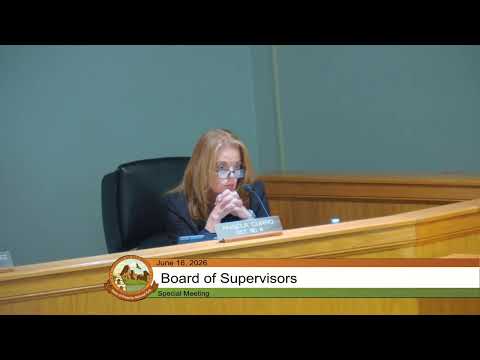
Other supervisors pressed for transparency in the data and operational detail: several asked staff to roll department budget requests from OpenGov into the county’s ERP system line-by-line so the board can compare prior‑year actuals and requested amounts, to provide department briefings on state‑mandated services that rely on general fund support, and to run cannabis revenue scenarios for possible inclusion. County staff and the consultant (Leanne Link) said they will attempt to roll requests into ERP by the end of the week and return to the board at workshops scheduled for June 24 and possibly June 26.
After public comment and discussion, the board passed a motion directing the CEO to work with the sheriff and fiscal staff to return costed projections for the proposed hiring and retention incentives (including probation in the analysis), to review OPEB and potential reductions tied to unfunded state mandates, and to identify department reductions or other balancing options without staff cuts where possible. The motion passed 4-0 with the board expecting options at the June 24 workshop and a likely final vote on June 26.
Next steps: staff will prepare detailed scenarios for the board on the sheriff incentive programs, OPEB options, potential cannabis revenue estimates, and department-level adjustments, and will roll requested budget items into ERP for line-by-line review ahead of the June 24 workshop.