Get Full Government Meeting Transcripts, Videos, & Alerts Forever!
Get email alerts on the Energy Infrastructure topic
No spam. Unsubscribe anytime.
Planning commission recommends delaying Cotati ordinance to expedite hydrogen‑fueling permits until 2028
Summary
After a staff presentation on SB 1418 and public testimony highlighting safety and lifecycle concerns, the Cotati Planning Commission voted 5–0 to recommend the City Council not adopt the proposed administrative hydrogen‑fueling permitting ordinance now and to return the item in early 2028.
The Cotati Planning Commission voted unanimously to recommend that the City Council not adopt the proposed ordinance implementing the state streamlined permitting process for hydrogen fueling stations at this time and to return the matter in early 2028.
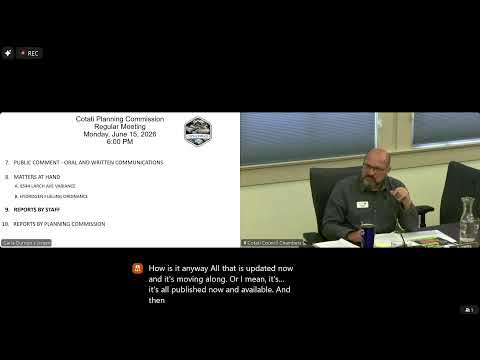
Carla Duncan, a permit technician in the Community Development Department, presented staff’s draft ordinance and explained SB 1418 (California Government Code §65850.7) requires cities to adopt an administrative, checklist‑based permitting pathway for qualifying hydrogen fueling stations that meet state safety standards. Staff proposed a 30‑day checklist review for projects that meet objective safety and zoning standards, online submittal options, and a municipal code amendment (Cotati Municipal Code §14.38.060) incorporating objective requirements and inspection protocols. Staff noted qualifying sites must typically be in commercial/industrial zones without residential units or on parcels previously developed as service stations, and that the city has until September 30, 2028 to adopt implementing rules.
Public comment was mixed. Several speakers urged caution and questioned the climate and safety claims for hydrogen fueling. One commenter stressed that much hydrogen in the U.S. is produced from natural gas and said hydrogen’s greenhouse‑gas benefits depend on production method. Another cited reported incidents and safety concerns and argued the city should prioritize electric‑vehicle charging infrastructure. By contrast, a speaker from the Sonoma County Climate Action Network and other advocates said permitting hydrogen stations can help grow a low‑carbon industry and noted emerging producers of hydrogen in the region.
Commissioners asked staff whether the city could use local code language to prohibit ministerial approval next to existing residences; staff said state law constrains what local governments can require for the ministerial pathway but that non‑fueling components (for example a convenience store or restrooms) could still trigger discretionary review. Staff also confirmed the local fire district had reviewed and provided comments on the draft language.
After deliberation, and citing substantial state action and unresolved questions about safety, lifecycle emissions and evolving regulation, the commission moved and approved a recommendation that the council not move forward with the proposed resolution now and that staff bring the ordinance back to the commission in early 2028 (ahead of the September 30, 2028 compliance deadline). The motion passed on a roll call vote of 5–0 (Commissioners Sparks, Berman, Moffett, Vice Chair Gelardi and Chair Long).
Staff will convey the commission’s recommendation to the City Council and may revise the draft ordinance based on the commission’s requested caveats (for example reconsidering general‑plan consistency language, clarifying public health and safety provisions, and verifying whether the city can lawfully limit ministerial approvals adjacent to residences). The deadline to adopt implementing regulations from SB 1418 remains September 30, 2028.