Get Full Government Meeting Transcripts, Videos, & Alerts Forever!
Get email alerts on the Pension Funding topic
No spam. Unsubscribe anytime.
Mendocino County retirement board adopts most actuarial changes but defers decision on lowering discount rate
Summary
At its June 16 meeting the Mendocino County Board of Retirement adopted most changes from its experience study — including new mortality and demographic assumptions — but deferred a recommended drop in the investment return assumption (from 6.50% to 6.25%) for review by the incoming actuary, citing county budget concerns and requests for additional analysis.
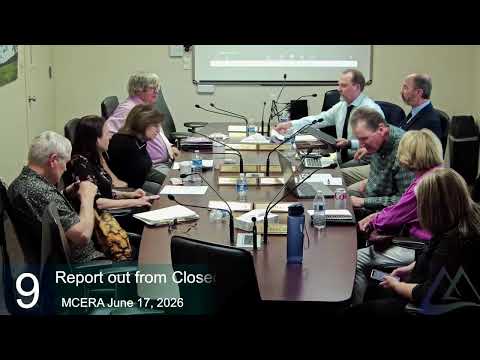
The Mendocino County Board of Retirement on June 16 adopted a package of assumption changes recommended in an experience study by its outgoing actuary but delayed voting on the recommendation to lower the plan’s net investment return assumption from 6.50% to 6.25%.
Dan Siblick of Seagull, the outgoing actuarial firm, told trustees the firm’s analysis supports moving to a 6.25% net return and that the change — together with updated mortality tables and other demographic adjustments — would raise average employer contribution needs by several percentage points in the model valuation. "The highlights on this page are that the investment return assumption, the recommendation is to lower it from 6.5 to 6.25," Siblick said during the presentation.
County officials and employee representatives urged caution. Sarah Pierce, assistant CEO for Mendocino County, told trustees the county "does not ... have the capacity to absorb about a 3 to 4 million increase," and asked for further analysis with the incoming actuary. Patrick, a field representative for SEIU Local 1021, echoed that position and asked the board to "maintain the current discount rate" while the county’s budget pressures are evaluated.
Board counsel reviewed state law governing actuarial assumptions (Cal. Gov. Code § 31453), noting the statute contemplates the board adopt the actuary’s recommendation but that trustees also have to act consistent with their fiduciary duties. Trustees debated options including accepting the recommended 6.25% now, keeping the current 6.50%, phasing any employer‑rate increases, or treating administrative expenses as an explicit rate charge instead of netting them inside the discount assumption (a bookkeeping change presented by the actuary that would materially lower the immediate employer contribution impact).
After discussion the board voted to adopt the study’s demographic and other technical changes, but to delay action on the investment return assumption. The board asked incoming actuary Chiron, which is completing a transition and replicating the last valuation, to review the capital‑market inputs and return assumptions and to return with analysis in August. A motion adopting the other assumption changes and deferring the rate passed on a roll call vote.
Trustees and staff noted timing considerations: any change to the assumed return would be reflected in the June 30, 2026 valuation and the employer rates presented to the Board of Supervisors (rates typically take effect the following fiscal year). Actuaries said using alternate capital‑markets inputs (for example the broader Horizon dataset) would move arithmetic return estimates modestly (examples discussed ranged from about 6.36% to 6.39%), but that choice of adjustments, expense treatment and risk adjustments also determine the final rounded recommendation.
The board’s next procedural step is the Chiron review; trustees asked staff to work with the county executive office on any fiscal‑impact illustrations and to bring Chiron’s findings back to the board before finalizing the investment return assumption. The 6/30/2026 valuation will proceed using the assumptions the board adopts after that review, and any employer contribution changes would be phased and reported as part of the valuation process.