Get Full Government Meeting Transcripts, Videos, & Alerts Forever!
Get email alerts on the Special Education Contracts topic
No spam. Unsubscribe anytime.
Sutherland board approves larger ESU16 special-education contract after detailed budget review
Summary
The Sutherland Public Schools Board approved the ESU16 contract and related distance-education and Title I agreements after ESU administrators explained a roughly $48,000 increase tied to higher student service counts, credentialed staff costs and state-approved rates.
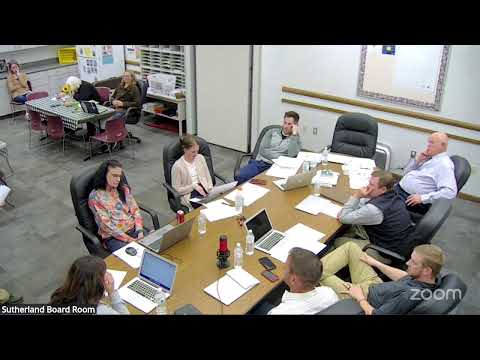
The Sutherland Public Schools Board unanimously approved a package of agreements with ESU16 on April 15 after ESU administrators outlined why the district's special-education contract rose substantially for 2025–26.
ESU16 administrator James McGowan told the board the agency cannot make a profit on these contracts and that the increase reflects service demand and credentialed staff costs. “We cannot make money... three things that you guys get services for: teaching and learning ... network operations ... and special education contracts,” McGowan said, explaining state levy limits and that some services (teaching and learning) are provided at no charge. He added that many special-education roles carry advanced degrees, which contributes to higher salaries and benefits costs.
Jennifer Pollson, ESU16’s special-education director, gave a line-item explanation: early childhood special-education costs rose from about $104,000 last year to roughly $122,000 next year because more children now receive services; some speech-language-pathology lines fell where fewer students needed that service. Occupational and physical therapy lines increased when more students’ individualized education programs (IEPs) required those services. Pollson emphasized that billing is based on the students actually served and that ESU16 makes a final adjustment to the district's last installment to reflect actual usage.
Board members asked about roster counts, how ESU16 estimates service needs and how state-approved rates are applied. Pollson said the ESU uses monthly rosters and referral tracking to estimate caseloads and prefers to estimate high to avoid underbilling; final bills will be reconciled to services provided. McGowan noted roughly 80% reimbursement from the state for special-education costs and urged the district to watch for any legislative changes to that rate.
After the presentation and questions, the board moved to approve the ESU16 contract along with the Southwest Nebraska Distance Education Network agreement and a Title I memorandum of understanding. A roll call recorded unanimous support from board members (Shad Lantis, Kyle Stevenson, Tom Kelly, Eric [first name only in the record], and Randy Busher). The motion carried.
What happens next: administration will receive the executed contracts and ESU16 said it will adjust the district’s final installment bill to reflect actual services rendered. The presenters invited board members to contact ESU16 staff with follow-up questions about rosters, service counts and specific program costs.