Get Full Government Meeting Transcripts, Videos, & Alerts Forever!
Get email alerts on the Bonds topic
No spam. Unsubscribe anytime.
Bond counsel briefs Citizens Oversight Committee on Prop 39 duties
Summary
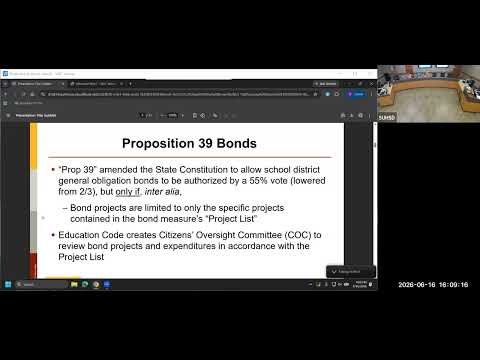
Bond counsel Meredith Johnson told the Sequoia Union High Citizens Bond Oversight Committee that Prop 39 lowers the voter threshold for school bonds to 55% and imposes accountability requirements — a project list, performance and financial audits, and an annual report — and reviewed the committee’s watchdog role and Brown Act constraints.
Meredith Johnson, bond counsel and chair of the bond practice group at Danis Wver Kelly, told the Sequoia Union High School District’s Citizens Bond Oversight Committee on Friday that general obligation school bonds in California most commonly use the Prop 39 framework, which lowers the voter‑approval threshold to 55% but adds specific accountability requirements.
Johnson said Prop 39 requires districts to publish a project list in sample ballots and to provide two audits — a performance audit and a financial audit — plus an annual report to the board. "In exchange for letting school districts pass measures with only 55% they increase the state legislature increase the requirements on those school districts," she said.
The committee’s statutory functions under the Education Code, Johnson said, are to inform the public how bond proceeds are spent, to review and report on those expenditures, and to advise whether the district met the constitutional limitations that bond proceeds be used only for construction, reconstruction, rehabilitation or replacement of school facilities and related furnishing and equipping. "Your job is to explain to those around us in the surrounding community about how expenditures are being made," she said, and added that the committee is not the board’s public‑engagement conduit; public comment belongs to board meetings.
Johnson explained allowable uses and limits: bond proceeds may not be used for general teacher or administrative salaries, but may pay district employees for time directly attributable to bond projects. She cited a common "but‑for" test used in accounting: if the expense would not have been incurred but for the bond project, it may be bond‑eligible.
She reviewed committee mechanics: the district must post oversight information on the internet, provide the audits by March 31 each year, and respond to any audit findings within three months. Johnson also highlighted conflict‑of‑interest rules that bar vendors, contractors and district employees from serving on the oversight committee.
On open‑meeting rules, Johnson said the Brown Act requires agendas be posted 72 hours before a public meeting and warned that serial communications — e‑mail chains or social media interactions among a majority of members — can create violations. She recommended routing substantive staff questions through the committee chair to avoid inadvertent serial meetings.
The briefing closed after committee members asked clarifying questions about term limits, membership recruitment and the content and timing of the annual report.