Get Full Government Meeting Transcripts, Videos, & Alerts Forever!
Get email alerts on the Historic Overlay topic
No spam. Unsubscribe anytime.
Moratorium meeting advances Bowmansville overlay planning; Town Line overlay set aside
Summary
At a June 15 moratorium meeting, participants agreed not to pursue a historic overlay in Town Line Hamlet, reviewed Bowmansville boundaries covering roughly 600 properties, debated overlay standards versus rezoning to protect neighborhood character, and asked staff to produce a red-lined zoning map for the next meeting.
A moratorium meeting on June 15, 2026, focused on whether to create historic overlay protections for two hamlets and how any overlay would interact with existing zoning and environmental overlays.
Participants first agreed that Town Line Hamlet did not need a historic overlay, removing that area from further consideration during this moratorium process. Moderator statements at the start of the discussion framed Town Line as already settled: "I believe that we're pretty much in agreement that we do not need a historic overlay district in Town Line Hamlet." The committee sought no objections and none were raised at that time.
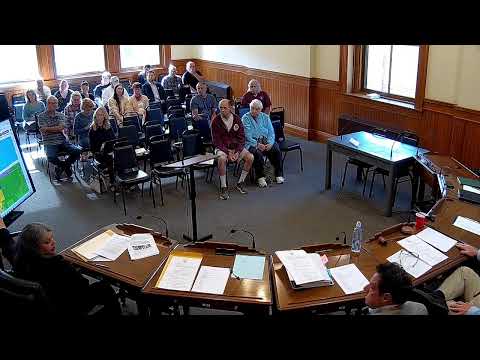
With Town Line off the table, the meeting turned to Bowmansville, where staff reported they had identified roughly 600 properties within the boundaries the committee set previously. Cindy (staff) displayed a zoning map and Matt (planning staff) walked attendees through the map’s color key: "the pink is your general commercial, the dark blue is the mixed use, the yellow is residential, and the orangey peach is multi-family," he said. Participants examined a pink commercial parcel where a hotel had been proposed; speakers noted that parcel’s status (potential split, proximity to Transit Road) and constraints including flood-plain and other environmental overlays that limit redevelopment.
A central question for the committee was what an overlay should protect. Two broad approaches emerged: use-focused overlays that constrain permitted uses (for example limiting industrial or high-traffic commercial uses), and design-focused overlays that set architectural or materials standards. Brad (committee member) and others recommended keeping restrictions light on ordinary homeowner activities (for example, not requiring approval just to replace a front door), while still using overlays or targeted rezoning to protect walkability and the hamlet’s small-scale character.
Committee members and residents proposed a compromise buffer strategy for the commercial edge along Transit Road: reclassify a short line of parcels to mixed-use to provide a transition between Transit Road commercial development and the adjacent residential hamlet while allowing existing businesses to continue as legal nonconforming uses. Staff explained the legal implications: existing lawful businesses would generally remain "legal nonconforming" if zoning changes but could lose that status if operations ceased beyond the specified period (discussed at the meeting as 12 months).
Environmental overlays (floodplain, wetland, woodlot) were noted as additional constraints on development for several parcels; staff said these overlays already make some sites economically impractical to develop. Speakers repeatedly emphasized the need to align any overlay or rezoning recommendations with the town’s comprehensive plan so the town can reference the plan when pursuing grants for sidewalks, walkability and related infrastructure.
Practical next steps set by the group included asking Cindy to outline the Bowmansville Hamlet in red on the zoning map and prepare a revised map showing proposed cutoffs and buffer areas for the committee to review at the next moratorium meeting. The moderator also noted a state-level bed tax had moved through the legislature and, pending the governor’s signature, proceeds could be directed toward local policing or other responses tied to hotel-related concerns.
On enforcement concerns, staff clarified the code-enforcement process: formal enforcement or inspections generally follow a formal complaint or involve an operator/tenant invitation; periodic inspections also occur between enforcement cycles. Staff encouraged residents to file formal complaints where appropriate so inspections and enforcement actions can proceed.
The meeting adjourned with the committee directing staff to return with a red-lined map and more detailed options at the next moratorium meeting; no formal vote was recorded on any ordinance or rezoning during this session.