Get Full Government Meeting Transcripts, Videos, & Alerts Forever!
Get email alerts on the Public Art Conservation topic
No spam. Unsubscribe anytime.
Conservation group offers Cerulean Warbler mural and curriculum resources to Brown County schools
Summary
Edward Ullman, representing a Southern Indiana conservation partnership, offered a three-panel Cerulean Warbler mural and school outreach materials to Brown County School Corporation at no cost, describing habitat-restoration work in the Brown County Hills and preliminary survey results suggesting increased local warbler counts.
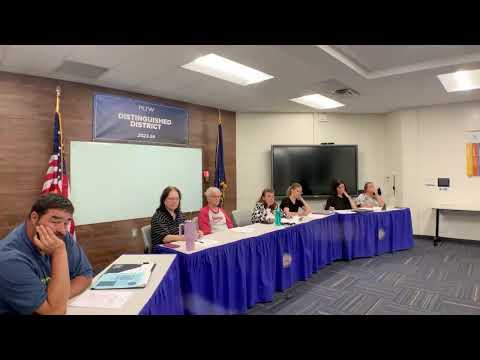
Edward Ullman, a representative of a Southern Indiana conservation partnership, told the Brown County School Corporation board on June 15 that his group has created a community-painted Cerulean Warbler mural and would like to place it in the community and provide accompanying educational materials to local schools at no cost to the district. "This is our mural. It is 5 ft tall and 12 ft across," Ullman said, describing three canvases (each 4 ft by 5 ft) assembled as a single display and protected with a waterproof coating.
Ullman said the mural is part of broader outreach connected to habitat-restoration work in the Brown County Hills, one of the species's remaining strongholds. "In the last 50 years, we've lost a little over 70% of their global population," he said, and described two small restoration units where survey counts rose from five to 16 birds after treatment, a result he called "anecdotal" pending fuller analysis.
Board members and staff asked practical questions about installation and maintenance. Ullman said the canvases are framed and could be bolted to a wall; his group would provide hardware, installation and removal at no cost and would replace the mural if the community later wished to remove it. Emily Callahan, an administrator on the board packet (and an early point of contact), said the district could pursue available wall space and potential grant funding to support future, larger public-art projects.
Ullman also offered school-centered materials such as coloring pages and a short curriculum about forest management and migration. He suggested elementary classes could help repaint panels in later years so the mural could be refreshed as a community project. The board thanked Ullman for the offer and invited further coordination with district staff.
What happens next: The district did not vote on the mural. Board members encouraged staff to follow up with Ullman about suitable wall locations, logistics and any permits or insurance requirements before a formal placement.