Get Full Government Meeting Transcripts, Videos, & Alerts Forever!
Get email alerts on the Municipal Budgeting topic
No spam. Unsubscribe anytime.
Budget committee splits big omnibus items, tweaks tax and public-works funding ahead of March ballot
Summary
At a Jan. 8 joint meeting, Limerick’s budget committee and select board split large omnibus warrants for public works and public safety into separate ballot articles, adjusted several appropriations (including unemployment/workers’ comp and a $53,000 transfer for road shoulder gravel), and removed a proposed energy-efficiency item pending clearer capital funding language. The meeting exposed gaps in how some fund transfers were posted and led to a decision to rewrite or move large transfers to a special town meeting.
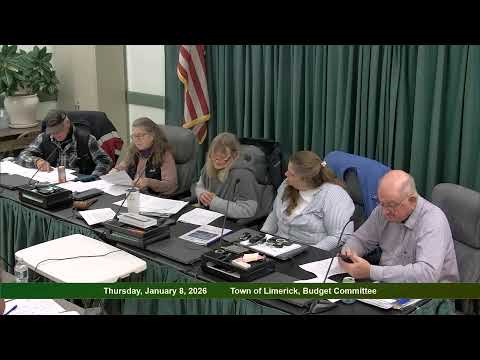
The Limerick budget committee and select board met jointly on Jan. 8 to finish final votes and wording for the March warrant, approving a series of recommendations while reorganizing several large omnibus articles into smaller, voter-facing questions.
Chair opened the meeting by asking that comments stay civil and that public remarks be limited to questions only to speed the final review. The committee moved through dozens of warrant articles, accepting the wording of routine items — such as a $7,500 appropriation for invasive-plant and boat monitoring — and recording its recommendations for voters.
Two of the meeting’s largest outcomes were structural: members voted to split a previously omnibus public-works article into separate ballot questions for (1) waste and sanitation; (2) repair of highways; (3) paving; and (4) snow removal and town properties/sidewalks. The board gave similar treatment to public-safety funding, breaking a single, roughly $1 million article into separate questions for the fire department/emergency personnel, emergency management, animal control, constable services, and street lights/hydrant rental. Supporters said the change aims to make each item more transparent to voters and reduce the risk that a single large package will be rejected at the polls.
“It’s better for voters to see these as distinct choices,” a committee member said during the debate over Article 31, noting that voters rejected a large omnibus article in a prior year. Road commissioner Ricky Richardson explained the operational need behind the public-works split, saying the paving increase is intended to ‘play catch-up’ on deferred maintenance.
Budget adjustments and clarifications
The committee adjusted several dollar amounts after reconciling invoices and carryovers. It increased the recommendation for unemployment and workers’ compensation to $78,000 total to reflect an extra payroll true-up and projected hires. For the earned paid leave account, members asked staff to rewrite Article 19 to explicitly carry forward an unexpended balance and then raise the residual amount; that rewrite was requested because December 31 balances and posted payables produced different summary figures.
The board also approved a transfer of $53,000 from unassigned fund balance into the repair-of-highways account to finish shoulder gravel work on Stonehill Road. That transfer was described as completing work that had been started in the prior fiscal year.
Debt, capital and accounting questions
The meeting surfaced several accounting and timing questions that the treasurer and committee said require outside review. Members amended Article 43 to make clear the $122,726 request for the new fire station is for principal and interest and to indicate the loan is in its second year of a 20-year repayment schedule. A larger proposed transfer (originally listed as $326,000 to reduce the 2025 tax commitment) prompted procedural concerns: the treasurer and others said the article’s wording did not unambiguously instruct staff whether the transfer should be applied to fiscal-year 2025 records, and auditors will be consulted before any attempt to post retroactive corrections. Because of that ambiguity, the board removed that transfer language from the warrant to be rewritten for a future meeting or a special town meeting if needed.
Energy-efficiency request removed pending clearer plan
An article to raise $30,000 for municipal energy-efficiency upgrades (lighting and insulation) was removed from the warrant after members argued the town should treat larger building upgrades as capital projects rather than one-year expenses. Members noted work already underway (heat-pump installs at several buildings) and a pending $75,000 energy-efficiency grant; the board decided to clarify the scope, funding source (ARPA vs. capital), and whether money should be placed in a multi-year capital account before asking voters to appropriate funds.
Votes and next steps
Committee votes recorded at the meeting include acceptances or recommendations on most line items and the formal decisions to (a) split the large public-works and public-safety articles for the ballot; (b) amend the fire-station debt-service warrant language; (c) remove the $30,000 energy-efficiency article for rework; and (d) transfer $53,000 to repair of highways for shoulder gravel. Several other transfers and capital-account creations (e.g., a $5,000 capital project grant-acquisition reserve and a $10,000 dry-hydrants reserve) were approved. The committee also asked staff to reword multiple articles and to consult the auditor and counsel about proper posting and closing of the 2025 books before any retroactive transfers are attempted.
The committee adjourned after confirming that revised warrant language will be prepared and checked with the treasurer and auditor so the warrant presented to voters on March 14 will reflect clear, legally actionable instructions for the town’s accounting staff.
What to watch next
- Whether the big splits (paving vs. repair vs. waste) appear on the March ballot as separate articles. - The treasurer’s and auditor’s guidance on posting transfers and on whether the $326,000 transfer (original draft) can legally be applied retroactively to FY2025. - Rewritten energy-efficiency language (capital vs. expense) and any related ARPA/grant match decisions.
Sources: Jan. 8 joint meeting of the Limerick budget committee and select board (warrant review).