Get Full Government Meeting Transcripts, Videos, & Alerts Forever!
Get email alerts on the Property Taxes topic
No spam. Unsubscribe anytime.
City staff recommends keeping Dunwoody millage at 3.040; resident criticizes staffing and timing at first public hearing
Summary
At the first of three public hearings on the FY2026 millage rate, city staff recommended maintaining the city mill at 3.040 while advertising a 0.125‑mill rollback change (advertised as a 5.69% revenue increase); a longtime resident urged cuts to payroll and earlier meeting times to boost public participation.
At a special Monday morning session, the Dunwoody City Council held the first of three required public hearings on the city’s proposed fiscal‑year 2026 millage rate. City staff recommended keeping the city millage at 3.040 but said state law requires the city to advertise a rollback calculation that results in a 0.125‑mill change; staff said the advertised net revenue effect is about $690,000 (about 5.69%) and that the typical homeowner’s increase would be roughly $3.75.
The recommendation comes as staff walked council members through how millage translates to a household bill: assessed values are 40% of market value in the city’s calculation, homestead exemptions and an assessment freeze reduce taxable value for many homeowners, and appeals or exemptions filed after the advertisement can substantially reduce the advertised increase before adoption. “We’re not proposing a millage rate increase. It will remain 3.040,” a city staff member said during the presentation.
The presentation also framed the city’s tax burden in context: staff said roughly 80% of a typical property tax bill goes to school operations and that about $350 of a typical bill — roughly 5% — supports city operations. Staff emphasized that many capital projects such as sidewalk or path construction are paid from a voter‑approved one‑cent sales tax reserved for capital projects (SPLOST), not the general fund property tax.
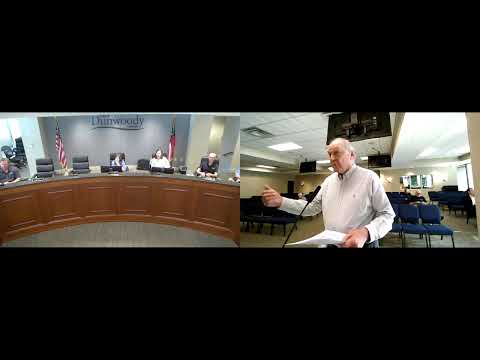
Public comment during the hearing focused on scheduling and city spending. Bob Hickey, who said he has lived in Dunwoody for more than 50 years, told councilmembers that holding hearings at 8 a.m. discourages public participation. “It’s absolutely disgraceful to have a public hearing meeting scheduled on a Monday morning at 8 a.m.,” Hickey said. He urged the council to cut expenses, particularly payroll, and argued the city should lower the millage rather than rely on continued increases: “The solution to our problem is cut expenses starting with payroll.”
Hickey cited figures from the city’s staffing and compensation guide and asserted non‑police staffing and payroll growth have outpaced residents’ incomes; the city presentation did not adopt or confirm the specific historical payroll percentages he cited. Councilmembers pressed staff on homestead audits and the tax commissioner’s role in verifying exemptions, with staff noting those audits occur at the county level and that appeals and exemptions in prior years reduced advertised amounts substantially before final adoption.
Councilmembers and staff also discussed neighboring cities’ approaches and recent state legislation. Staff noted that last year the city advertised a much larger net increase that fell after appeals and corrections, and referred to a state law passed this legislative session that limits assessed‑value increases for homesteads to 3% (effective for a later cycle), a change staff said may affect future school tax calculations.
No vote on the millage was taken during the special session; councilmembers recessed to continue discussion later. Councilmember Stacy moved to adjourn the special meeting and Tom seconded; the motion carried on a voice vote. The council indicated the millage item will return for further consideration at subsequent hearings required under state law.
Authorities referenced during the hearing included the state statute limiting homestead assessed‑value growth (described by staff as a recent legislative change) and the local voter‑approved one‑cent sales tax for capital projects (SPLOST), which staff said is the primary funding source for many sidewalk and transportation projects.
Clarifying details from the hearing: the staff recommendation was to maintain the city mill at 3.040; the advertisement used a rollback (advertised) rate of 3.025 and an advertised change of 0.125 mills; staff presented an estimate that the advertised revenue increase would be about $690,000 and that the average homestead homeowner’s additional tax would be about $3.75; staff cautioned appeals and exemptions can reduce advertised amounts prior to final adoption.
The council did not adopt a final millage at the special session; the matter will be revisited in the next scheduled hearings under the statutory adoption process.