Get Full Government Meeting Transcripts, Videos, & Alerts Forever!
Get email alerts on the County Budget topic
No spam. Unsubscribe anytime.
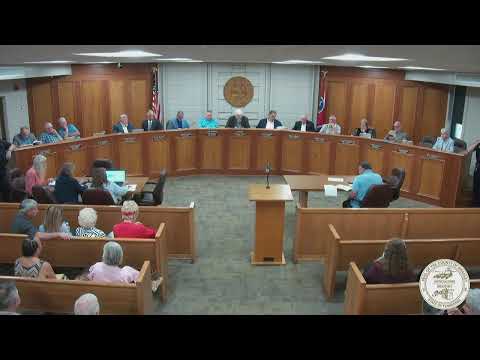
Bradley County commission approves FY2025–26 budget amendments after public comment on raises and taxes
Summary
The Bradley County Commission on June 15 approved final amendments to the 2025–26 budget after public comment split between support for a proposed 15% pay increase for county employees and opposition to any property tax increase.
The Bradley County Commission on June 15 approved final amendments to the fiscal-year 2025–26 budget after a roll-call vote, following extended public comment both supporting pay increases for first responders and urging commissioners not to raise property taxes.
Commissioner Blake moved to approve the "final budget amendments" (described in the meeting as end-of-year "true-ups"); Commissioner Slater seconded and the motion carried on a roll-call vote. The motion covered amendments to the current fiscal-year budget, not the next budget cycle. Commissioner Gilbert asked how an "8.5%" figure had been calculated and how it related to a separately discussed 15% pay increase; the mover clarified that the approved motion applied to FY2526.
The budget amendments drew substantial public comment. Ed Elkins, a former county commissioner, urged the commission to "vote no on a property tax increase," saying reassessments had already pushed property valuations higher and that new growth should fund raises rather than higher homeowner taxes. Courtney Berger, who identified herself as a Bradley County Sheriff's Office employee, told the commission: "The proposed 15% raise will help retain those quality employees," saying many first responders are leaving for neighboring agencies that offer higher starting pay. "More money would benefit my children," she said, and she thanked the mayor and commission for addressing pay.
Other speakers gave contrasting perspectives. Mary Wooten said seniors and fixed-income households would be harmed by higher property taxes and urged support for the mayor's budget as presented. John Humber, a multi-generational farmer, criticized county management and said he favors responsible budgeting over tax increases. Randall Gladson (self-identified as representing the fourth district) criticized the process, saying discussion of the 8.5% item had occurred over weeks and raising transparency questions.
Caitlyn Arceri provided factual context the finance committee cited in advance of the vote: she said a 2007 Tennessee Advisory Commission on Intergovernmental Relations report used older (2005) data, and she cited more recent statewide data from the Tennessee Comptroller (2025) to say Bradley County ranks among the lower property-tax-burden counties. Arceri emphasized statutory limits on reallocating revenue, noting that "50% of sales tax revenue is required to go to education" and that hotel/motel taxes are restricted to economic development and tourism, and described the proposed pay adjustment as "a market correction to adjust a longstanding ... pay gap." Her remarks underscored the narrow flexibility in many county revenue streams.
Votes at a glance • Approval of minutes — motion carried by roll call (mover: Commissioner Hughes; second: Commissioner Goins). • Consent agenda — motion carried by roll call (mover: Commissioner Slater; second: Commissioner Hughes). • FY2526 final budget amendments — approved by roll call (mover: Commissioner Blake; second: Commissioner Slater). • Meeting agenda approval — approved by roll call.
What happens next: The commission announced a special-called meeting for Friday, June 26 at 12:00 p.m. at the Bradley County Courthouse. The budget amendments approved on June 15 apply to the current fiscal year; future compensation policy or tax-rate changes would be considered separately in later proceedings.