Get Full Government Meeting Transcripts, Videos, & Alerts Forever!
Get email alerts on the Housing topic
No spam. Unsubscribe anytime.
Housing foundation urges tiered targets and zoning tools as Concord prepares for MCI redevelopment
Summary
Matt Johnson presented a housing-strategy memo asking Concord to set tiered production goals, use town-owned RFPs and zoning incentives (including Chapter 40Y starter-home options) to address a shrinking 'middle' of housing affordability as the MCI Concord redevelopment moves forward.
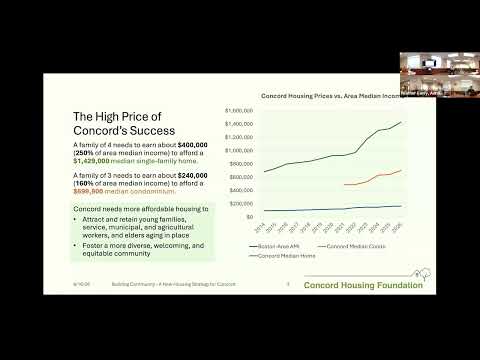
Matt Johnson, speaking as a member of the Concord Housing Foundation and chair of the Affordable Housing Trust, told the Planning Board on June 16 that the town faces a pronounced affordability problem and should adopt new, tiered housing targets to guide the MCI Concord redevelopment and other projects. “We have a housing crisis on our hands,” Johnson said, noting a median single-family assessed value near $1.4 million and a condo median near $700,000.
Johnson said demographic shifts and falling school enrollment make producing new housing a local priority: “For the first time we’re seeing declines in school enrollment that are kind of on a permanent trajectory that we would need to compensate for by growth in housing.” He told the board the foundation’s memo is not a substitute for a formal Housing Production Plan but is meant to provide guidance to planners, consultants and boards as MCI and other sites are planned.
The memo proposes setting separate goals for very-low-income, low-income (around 80% of area median income, or AMI) and “attainable” middle-tier housing, and expanding incentives and zoning tools to produce smaller and denser units. Johnson said Concord already meets the state’s 10% subsidized-housing inventory threshold on paper, but that the town’s bona fide affordable units are roughly 405 of about 7,200 units (about 6–7%), below what residents may assume on the state’s list.
Johnson urged the town to use tools available when the town owns a site — notably issuing RFPs that prescribe development patterns and use PRD density bonuses — and recommended exploring Chapter 40Y (starter-home zoning, with a typical maximum house size of about 1,875 square feet) as a tool for creating cottage-district, “missing-middle” housing. “If the town owns the site, we can actually determine the type and pattern of zoning that could go onto the site,” he said.
Board members pressed Johnson on fiscal and service impacts. A board member asked about police, fire and other municipal-service costs; Johnson summarized his view that police and fire add relatively modest per-unit tax impacts (on the order of a few hundred dollars per unit) while infrastructure and other costs are harder to quantify and will be informed by the MCI economic-impact analysis now underway.
Johnson presented production scenarios: the Affordable Housing Trust has set a near-term five-year goal of 200 new affordable units across all tiers, and Johnson said existing 40B and other projects already account for part of that total (one set of 40B projects was described as about 111 units at the 80% tier; Habitat for Humanity is building three units on Old Marlboro Road). He estimated that a fully developed MCI Concord site under some proposals (800–1,000 units) could materially move Concord toward longer-term housing targets.
Pat Nelson and other board members asked for clearer methodology and visuals—the school-impact slide and some charts were described as confusing—and Johnson agreed to provide a revised slide deck and supporting explanations and to circulate the final memo to the board for comment. “We’ll email it to everybody,” he said.
Next steps: Johnson said the foundation hopes to finalize the document at an upcoming housing roundtable and provide the memo as input to the MCI master-plan process. The Planning Board and staff signaled they will use the MCI economic-impact analysis and forthcoming surveys and public meetings to refine decisions and public messaging.