Get Full Government Meeting Transcripts, Videos, & Alerts Forever!
Get email alerts on the Drought Water Quality topic
No spam. Unsubscribe anytime.
Drought raised to Level 2; resident protests watering rules; town reports lead sampling and a meter-replacement plan
Summary
The state raised Orleans' drought status to Level 2 (handheld/drip only). Resident Brian Nelson urged fair, consistent watering rules and proposed limited early-morning irrigation for private wells. Staff reported 93 lead samples taken at NASET Regional Middle School and recommended replacing source water meters (estimated equipment cost ~$35,000) to reduce unaccounted-for water.
Town staff told the board the Executive Office raised the drought classification to Level 2 on June 9, which restricts outdoor water use to handheld watering and drip irrigation only under the town’s water-management permit. Staff clarified that some parks and recreation properties (for example Eldridge Park) have exemptions, but most town properties, including schools and town hall, are not exempt.
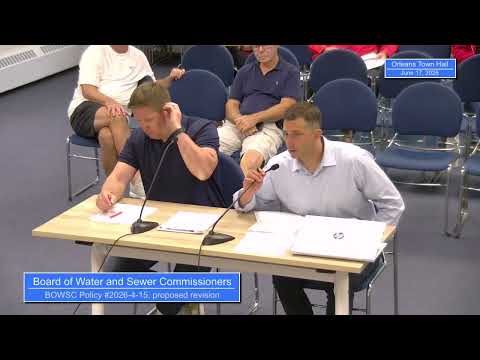
During public comment, resident Brian Nelson said the rules are confusing and unevenly enforced — he noted he uses a private well for irrigation and proposed a short, efficient early-morning irrigation window as an alternative to the town's hand-watering schedule. Nelson warned that inconsistent rules create neighbor animosity and urged the board to be fair in applying restrictions.
In water-quality work, staff reported sampling 93 points through UMass’s Water Smart program at NASET Regional Middle School and said plans from Ron Collins for Orleans Elementary will be submitted to UMass for likely sampling in September. The M36 water-loss audit recommended replacing source-water meters and the finished-water meter; equipment-only estimates for purchasing new meters are roughly $35,000, not including any engineering assistance. The audit also recommended adding cellular transmitters to source meters to detect anomalies and reduce unaccounted-for water.
Staff said the town’s unaccounted-for-water dropped to about 7% after earlier meter work and quarterly billing but has drifted upward in subsequent years; the meter-replacement recommendation is intended to address that trend and improve leak detection.