Get Full Government Meeting Transcripts, Videos, & Alerts Forever!
Get email alerts on the Buckman Brewhouse Special Use topic
No spam. Unsubscribe anytime.
Buckman Brew House appeals Planning Commission denial, cites shared downtown parking and city code exclusion
Summary
Buckman Brew House asked the Cabot Planning Commission to reverse a previous denial of a special use permit for a restaurant/brewery at 114 West Pine Street, presenting a city parking agreement, photos and a code interpretation indicating C1 properties are excluded from off-street parking requirements.
The Cabot Planning Commission reopened public comment on a special use permit for Buckman Brew House, a proposed restaurant and craft brew operation at the Old Firehouse, 114 West Pine Street, after the City Council returned the application for further review.
Vice Chairman Ronnie Low presided after the chair recused themself, saying they were the architect for the project. City staff member Laura Bird told the commission the council held an appeal hearing on Jan. 6 and voted to send the item back because new information had been introduced. Bird also said the applicability of off‑street parking requirements excludes C1‑zoned properties — an issue missed during the initial technical review.
Kim Robbins, co‑owner and head baker of Buckman Brew House, and Ranna Smith, co‑owner, told commissioners they were appealing the Planning Commission's earlier denial, which had been based on parking and traffic concerns. Robbins said the applicants compiled new evidence showing 74 public parking spaces in the municipal lot and a parking agreement with the city for additional spaces behind the City Annex.
"We want to preserve a piece of history and bring back the pride of Cabot to the Firehouse," Robbins said, explaining the applicants' vision for a farm‑to‑table restaurant, bakery and brewhouse in the downtown revitalization effort. Ranna Smith said the Old Firehouse has served several civic functions historically and that the project aims to be a downtown gathering place.
The applicants presented a maximum occupancy figure of 102 and said, under their reading of Cabot City Code 4.10.1, off‑street parking requirements do not apply to properties in the C1 Central Business District. They argued employees are included in the occupancy count, so no separate employee parking is required, and that the municipal lot is underutilized at typical restaurant peak times. "On Saturdays and Fridays during peak hours the lot is completely empty," the presenters said while pointing commissioners to time‑stamped photos they provided.
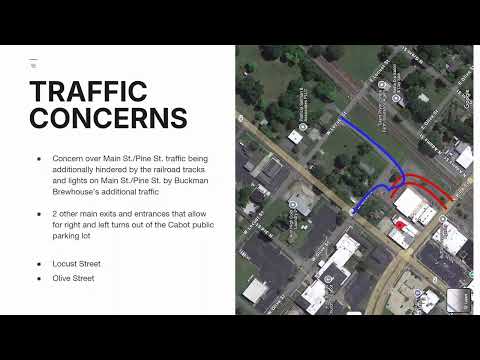
To address traffic concerns on Main Street near the railroad crossing, the applicants identified two alternate egress routes from the municipal lot — via Locust Street and Olive Street to Highway 367 — and said those choices would reduce additional traffic on Main Street. They also noted that municipal court no longer meets at the Annex, which the applicants said will further reduce competing parking demand.
Commission members had previously expressed concerns about on‑site parking, employee spaces, and potential traffic impacts on Pine and Main streets; the applicants provided a slide package, a city parking agreement and photos to respond. Planning staff framed the technical issue for commissioners, noting the council's determination that new information warranted revisiting the commission's prior vote.
The record at this meeting included the staff report explaining the council remand and the applicants' materials showing the parking inventory, the Annex parking agreement and example photos of parking conditions at different times. The commission discussion and any final vote on the special use permit were not recorded in the portion of the transcript provided.
The hearing remains open for the commission to ask additional questions and make a final determination after considering the newly submitted evidence.