Get Full Government Meeting Transcripts, Videos, & Alerts Forever!
Get email alerts on the Municipal Governance topic
No spam. Unsubscribe anytime.
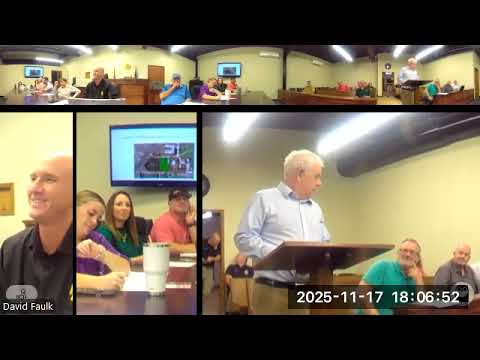
Prairie Grove council approves waste-rate, zoning and personnel measures in Nov. 17 meeting
Summary
The Prairie Grove City Council on Nov. 17 adopted multiple ordinances and resolutions: updated commercial solid-waste rates, rezoned a Barnett parcel for single-family use, accepted donated park land, authorized a downtown easement contract, and adopted personnel-policy updates and a mayoral pay increase.
Prairie Grove’s City Council adopted a slate of ordinances and resolutions on Nov. 17 that adjust fees, update personnel policies and move forward several land-use and downtown projects.
Council members approved an ordinance to codify prior solid-waste rules and raise commercial collection rates to better cover current costs; staff presented example fees including a 32-gallon container at $10 per month and dumpster pickup pricing that ranges by size and frequency. The ordinance passed by roll call.
The council also rezoned a tract on Richardson Road owned by Justin and Christopher Barnett from Mixed-Use (MUB2) to a single-family designation (R15) after a planning commission recommendation, citing the surrounding single-family neighborhood; the zoning map modification passed by roll call.
Other actions that passed included a resolution accepting two small lots donated by Cox Development LLC to expand the city’s Snyder Grove park land, authorization of a not-to-exceed contract with Millstones Inc. for downtown easement work (staff said $35,500 would be the worst-case cap, with expectations of a lower cost), and adoption of clarified fire and police personnel policies (including a five-day animal-hold policy and overtime/rate alignment for special events).
Council suspended the rules and adopted an ordinance to increase the mayor’s salary (first, second and third readings by title only were all waived and the measure was adopted by roll call).
Votes and process: motions for each ordinance and resolution were moved, seconded and carried; roll-call votes were recorded for several measures and voice votes were used for others. No failed motions were recorded in the transcript of this meeting.
What’s next: most adopted items were routine administrative or technical updates; the budget submission (including a $3,200 line for an oral-history project) will be finalized in the upcoming budget cycle and some contracts (downtown easements) will proceed to negotiation and execution.