Get Full Government Meeting Transcripts, Videos, & Alerts Forever!
Get email alerts on the Budget Fiscal Stabilization topic
No spam. Unsubscribe anytime.
LA Unified amends fiscal plan after board debate, preserves some BAP funding; broader cuts still proposed
Summary
After a daylong budget debate and months of public comment, the Los Angeles Unified School District board approved a revised fiscal stabilization plan June 16 that preserves partial Black Student Achievement Plan (BAP) funding and commits to prioritizing restoration of equity investments as state revenue materializes. The vote followed amendments and intense public testimony urging protection of BAP, SENI and community after‑school programs.
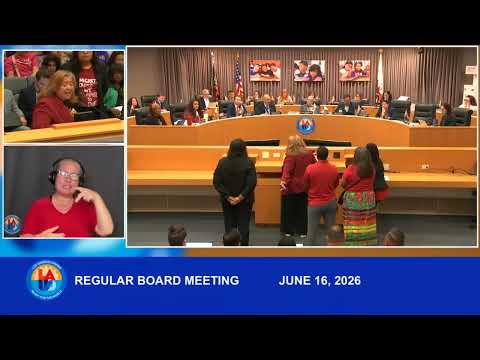
The Los Angeles Unified School District Board of Education approved a revised fiscal stabilization plan on June 16 after hours of debate, amendments and extensive public comment. The plan, required by the county to address projected multi‑year deficits, passed 5–1 after the board added amendments to protect some equity investments.
The board’s action came after presentations from two parent advisory committees and a detailed district budget briefing that laid out a three‑year, $3.6 billion shortfall driven by declining enrollment, expiring one‑time pandemic funds and rising compensation costs. Chief Financial Officer Sam Bravo Karimi told the board that general fund unrestricted compensation alone would outstrip revenues in later years unless the district reduced spending, raised new revenues, or both.
Why it mattered: Public speakers — parents, students, union leaders and community‑based after‑school providers — repeatedly warned that deep cuts to the Student Equity Needs Index (SENI) and the Black Student Achievement Plan (BAP) would result in layoffs of counselors, psychiatric social workers, school psychologists and other student supports, and would sever services at high‑need campuses. At times the meeting became heated, with two board amendments proposed to reduce the scope of cuts to equity programs.
What the board did: Two competing amendments were discussed and voted on. One amendment required staff to return in September with a plan to restore at least $25 million to BAP if additional state revenue materializes, and reallocated some central‑office reductions to partially restore $50 million of BAP funding for 2027–28. Another later amendment removed BAP from the FSP for 2028–29 and proposed drawing $175 million from the district’s OPEB (other postemployment benefits) trust to cover that year; that motion generated legal and financial concerns from staff and a mixed vote. The final approved package included the board’s commitments to prioritize BAP and SENI restorations when new state funds materialize and narrowed some proposed cuts.
What remains: The board approved the updated FSP so staff could finalize AB1200 disclosures tied to labor agreements. But district staff and some board members cautioned that several proposed cuts depend on negotiations (furlough days, health‑benefit cost‑sharing) and on the outcome of state budget actions; the county office of education monitors the plan’s feasibility and could intercede if it judges the plan imprudent.
Public reaction: Hundreds of parents, students and community partners urged the board to safeguard equity investments. Community leaders argued that BAP provides culturally specific supports — counselors, climate advocates and college‑access programming — that are not replicable by general‑purpose line items. After‑school providers warned that current contract reimbursement rates are insufficient and asked the board to allocate a modest pool of the district’s expanded‑learning dollars to community providers to avoid program closures.
Next steps: The LCAP (local control and accountability plan) and the 2026–27 budget remain scheduled for board action at the June 23 meeting; staff committed to bring back updated fiscal projections after the state’s final budget and to report at interim checkpoints this fall. The board also pledged to continue advocacy for additional state revenue to avoid deeper reductions.
Why residents should watch: The FSP and labor agreements together shape the district’s ability to staff schools and deliver services. The plan affects counselors and mental‑health staff whose work touches attendance and safety, and it influences whether community after‑school partners can remain viable. The practical outcome is that, even after amendments, many high‑need campuses face ongoing uncertainty until final state budget numbers and the results of labor negotiations are known.
Sources: Board presentations, LCAP and budget briefing by district staff; public comment from advisory committees, union and community representatives; board votes and amendments recorded at the June 16 meeting.