Get Full Government Meeting Transcripts, Videos, & Alerts Forever!
Get email alerts on the Kirkwood Closure topic
No spam. Unsubscribe anytime.
Mayor Thompson convenes public listening session on Kirkwood street closure
Summary
Mayor Thompson and Council Member Zulich held a public listening session in Bloomington to gather community views on keeping Kirkwood Avenue closed to vehicles for much of the year. Speakers ranged from disability advocates and seniors to business owners and younger residents, who debated accessibility, parking, economic impacts and needed infrastructure.
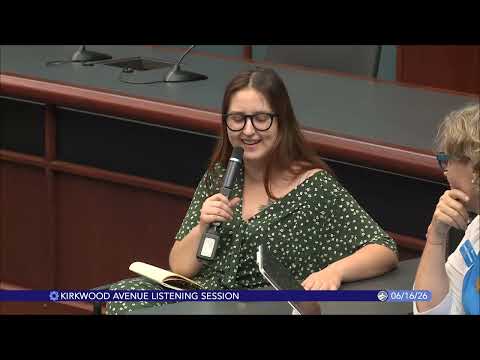
Bloomington Mayor Thompson on Wednesday night hosted a public listening session about whether Kirkwood Avenue should remain closed to vehicle traffic for most of the year, inviting residents, business owners and community groups to offer experience-based, solution-oriented comments before a final decision.
The mayor opened by saying the session was for public input, not a deliberation, and noted an extensive memo about the proposal is publicly available; she also said the city will proceed with a separate Kirkwood corridor plan and will incorporate community feedback into that work.
Speakers at the hour-plus meeting described sharply differing experiences of Kirkwood. Several people with mobility limitations urged the city to prioritize accessibility. "The ADA prohibits reducing or limiting accessibility," said Charlie Davis, who identified himself as visually impaired, and asked city leaders to discuss how ambulances or drop-offs would work if the street were closed. Wayne Shepard, a longtime resident, said he counted 22 handicap parking spaces in the downtown area and warned the proposal would remove about eight of those for seven months of the year, making it harder for people with breathing and mobility issues to access businesses.
Business owners and developers urged caution and called for more study of economic impacts. "A decision of this magnitude really requires a broader understanding of who the stakeholders are," said Mark Lachley, a local real estate developer, and Elliot Lewis, who identified himself as a downtown parking provider, cited a study he said showed revenue declines of 27 percent to 38 percent for lengthy closures. Operators said long closures hinder deliveries and can reduce foot traffic for businesses not located directly on Kirkwood.
Faith and service organizations also raised operational concerns. Reverend Carmen Ray of First Christian Church said the congregation relies on six proprietary parking spaces that are accessed from an alley off Kirkwood and warned that losing those spaces would harm the church's programs, including a weekly meal service and a winter emergency shelter.
Others argued that permanent or well-funded pedestrianization could increase downtown vibrancy if paired with infrastructure investment. "It needs a plan," Metra Farmer, a resident, told the meeting, listing shade, seating, bathrooms, staffing and programming as prerequisites. Several supporters urged the city to involve Indiana University and private partners, and to consider complementary investments such as parking garages, trolleys or pedicabs.
Speakers also raised public-safety and operations trade-offs. A former Bloomington Transit operations manager said prior closures forced rerouting that bypassed widely used stops, including service to the Monroe County Public Library, and warned of scheduling repercussions. Business owners and some residents described concerns about harassment and increased visibility of people experiencing homelessness during closures, arguing those issues must be addressed for public spaces to be broadly welcoming.
Younger residents and delivery drivers emphasized practical fixes that could make closures workable: more parking garages, reliable nonmotorized transit (pedicabs/trolleys), and public restrooms. A delivery driver who spoke said sustained closures create significant logistical burdens for pickups and drop-offs.
Throughout the meeting commenters repeatedly framed the choice as one of priorities and planning rather than a single binary. "What is the desired outcome?" one resident asked, urging officials to consider objectives, funding and long-term maintenance rather than only whether the street is open or closed.
Mayor Thompson closed by thanking attendees, reiterating that staff and council members would review comments and that she would "listen, discern, and then decide." No formal vote or ordinance was taken at the session; the mayor said the Kirkwood corridor planning process will continue and encouraged written comments from those who could not speak at the meeting.
What happens next: the city will record and review public input as it advances the corridor plan and before any final administrative or legislative action. The mayor said the public memo on the proposal is available and staff can provide printed copies upon request.