Get Full Government Meeting Transcripts, Videos, & Alerts Forever!
Get email alerts on the Lccc Accelerate topic
No spam. Unsubscribe anytime.
LCCC’s Accelerate pilot aims to boost access for first-generation students, donors back $800,000
Summary
Laramie County Community College described 'LCCC Accelerate,' a cohort-based advising pilot prioritizing first-generation and low-income students with donor funding (~$800,000), early outcomes for 91 students and plans to scale if advising and scholarship support are secured.
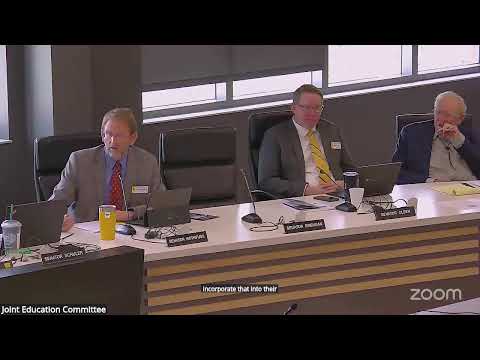
Laramie County Community College told the Joint Education Committee on June 18 about LCCC Accelerate, a proof-of-concept designed to help first-generation and low-income students use dual and concurrent enrollment to complete postsecondary credentials more rapidly.
Joe Schafer and Blake Peatner said the program recruited 91 sophomore students for the first cohort and emphasizes intensive career exploration and dedicated advising during the sophomore year, followed by structured on-ramps into junior and senior year dual/concurrent coursework tied to one of eight pathways. Peatner said the pilot offers workshops on time management and study skills and provides a one-year tuition-and-fee scholarship at LCCC after high school for completing an associate credential.
Schafer said the college raised about $800,000 from philanthropic partners (John P. Elbogen Foundation, Sturm Family Foundation and Meta) to run the pilot and expects to raise an additional ~$400,000 across the program’s duration. Early indicators the presenters reported: 91 students enrolled (target 100), five sophomores successfully completed spring college classes with A/B grades, 47 students were enrolled in concurrent courses during the spring, and 56 were enrolled in a dual-enrollment summer course just as the session began. Presenters emphasized the program’s targeted advising model and noted advising capacity is the chief scalability constraint: the pilot currently employs one Accelerate advisor drawn from K–12.
Committee members asked about advisor recruitment and per-student cost. LCCC said the advisor came from K–12 counseling and estimated a high-level average educational cost per full-time LCCC student of about $12,000; presenters and UW representatives cautioned that instructional costs are often sunk or fixed while advising and student supports are the primary marginal expenses when scaling dual-concurrent participation.
LCCC framed Accelerate as a model intended for replication if the state and institutions can align incentives, fund advising capacity, and preserve pathways that make credits count toward degrees. The college plans to enroll up to 300 students across three cohorts over five years for the pilot and said students could earn up to about 30 credits by graduation if they follow the on-ramps.
Next steps: LCCC will continue fundraising and provide follow-up data to the committee on outcomes and scalability concerns; the committee also asked staff to analyze how the state’s $10 million reimbursement appropriation will interact with pilots like Accelerate.