Get Full Government Meeting Transcripts, Videos, & Alerts Forever!
Get email alerts on the Dual Enrollment Overview topic
No spam. Unsubscribe anytime.
Wyoming committee hears evidence that dual enrollment boosts college entry but flags equity, advising and funding gaps
Summary
A Joint Education Committee heard a Legislative Service Office review, national research and local college testimony showing dual and concurrent enrollment raise postsecondary enrollment and completion, while committee members and BOCES officials raised concerns about inequitable access, advising capacity and overlapping funding streams.
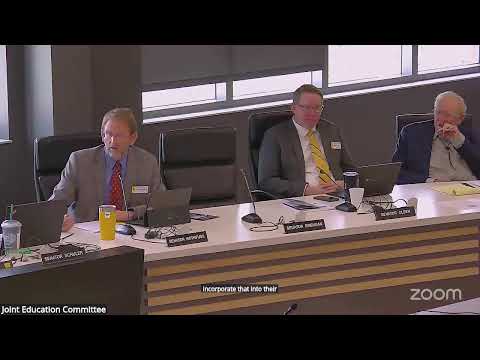
The Joint Education Committee on June 18 heard analysis and testimony showing dual and concurrent enrollment programs increase students’ likelihood of attending and completing postsecondary education, but committee members and local officials urged clearer funding rules and more advising to ensure credits lead to meaningful credentials.
Ashley Phillips of the Legislative Service Office opened the hearing by presenting the LSO memorandum comparing Wyoming’s statute (Wyoming Statute 21-22-01) and recent policy changes with models in Washington, Minnesota and Ohio. Phillips told the committee the legislature recently created a district reimbursement program that appropriated $10 million annually and separately directed $750,450 to the Community College Commission to expand access for non-public school students. She summarized that Wyoming’s framework leaves substantial execution to local MOUs between school districts and postsecondary institutions and that funding and access vary by district.
Laurel Ballard, executive director of the Wyoming Community College Commission, told the committee concurrent enrollment accounts for many more credit hours than dual enrollment in Wyoming and reported statewide completion rates she put at roughly 93.5% for concurrent enrollment and 87% for dual enrollment. Ballard said about two-thirds of the class of 2024 earned some dual or concurrent credit and that the average number of credits taken was about 13.6. She and other presenters cautioned that many credits are general-education electives that may not apply to a student’s eventual credential, and that students who accumulate large numbers of elective credits risk exhausting certain financial-aid eligibility.
Davis Jenkins of the Community College Research Center summarized national evidence, saying dual/concurrent enrollment raises enrollment and completion when programs are organized as intentional pathways rather than a loose collection of courses. Jenkins urged the state and colleges to map dual-enrollment offerings to clear career or degree pathways, embed college advising into high schools, and provide academic supports so college-level rigor benefits students who have not previously planned to attend college.
Laramie County Community College presented a pilot, LCCC Accelerate, aimed at cohorts of primarily low-income and first-generation students. Joe Schafer and Blake Peatner described the program’s model—cohort advising, eight pathway “on-ramps,” workshops in the sophomore year and a one-year scholarship to complete remaining tuition and fees after high school. They said the pilot enrolled 91 students in its first year, has donor support of about $800,000 with additional fundraising needed, and reported early positive indicators: strong student demand, early course success, and high summer enrollment in dual courses.
Multiple BOCES managers and K–12 leaders described how local mill levies, BOCES budgets and college agreements shape access. Gina Lamb Pickett (Central Wyoming BOCES) said her BOCES spends roughly $1.3 million annually—about 76% of its budget—on tuition, textbooks and advising and serves approximately 850 students per semester. Jeff Wasserburger (Campbell County BOCES) described a full-tuition scholarship program (Pronghorn Advantage) and said some students earn associate degrees by high school graduation, citing examples of students with 78–88 credits.
Committee members asked practical questions about cost and capacity. LCCC estimated an approximate educational cost of about $12,000 per full-time community college student and said many instructional costs are fixed while advising and student supports are marginal expenses that rise with program scale. Members debated whether the state should prioritize “pathways” tied to credentials or preserve broad general-education options for students who are undecided; presenters and committee members largely agreed both aims can be accommodated but will require increased advising capacity.
At the end of the meeting the Department of Education corrected an earlier statement about NAEP math, noting the 2017–2024 decline in eighth-grade math was statistically significant. The committee then adopted several next steps: forming working groups on standard-setting and state administration, requesting draft legislation to calculate charter-school ADM separately from district ADM for certain calculations, exploring a funding model akin to Washington’s Running Start (a 1.4 FTE funding stream), and directing the State Board of Education to provide guidance on physical education standards and appropriate disciplinary use of PE time.
What happens next: the committee asked staff to draft bill language and to form working groups to examine funding models, BOCES impacts and the advising supports needed to make dual and concurrent enrollment deliver consistent value statewide.