Get Full Government Meeting Transcripts, Videos, & Alerts Forever!
Get email alerts on the Animal Control topic
No spam. Unsubscribe anytime.
Hunt County court presses cities, vendors for plan as shelter fees rise
Summary
Hunt County commissioners pressed for a written 'statement of work' and intake data after Greenville and Commerce signaled higher kennel fees and staffing limits, leaving the court to weigh negotiating with cities, issuing an RFP, or contracting with third-party operators.
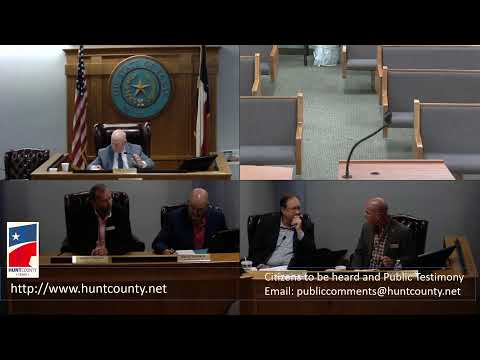
Hunt County’s Commissioners Court spent much of a special session June 16 focused on rising animal-control costs and gaps in field response after city shelters signaled steeper fees and cities stopped routinely retrieving animals outside their limits.
County Judge Stovall told the court Greenville has asked the county to share a larger portion of kennel costs after the city’s shelter budget rose sharply; the court discussed figures cited by city representatives that would move Greenville’s animal-shelter budget from roughly $100,000 to about $250,000. Stovall also noted Commerce’s contract includes an escalator and that the county currently pays one-third of Commerce’s animal-control budget.
Why it matters: Commissioners said the county’s taxpayers are already subsidizing city shelter fees to allow county residents to surrender animals at city rates. Several members warned that large fee increases risk driving owners to abandon animals rather than surrendering them, which would worsen public-safety and animal-welfare problems.
Court members and staff described operational shortfalls that a simple funding transfer would not solve: after‑hours and emergency pickups (for arrests, evictions or animal-bite incidents), transport to quarantine facilities, and lab shipping/testing for rabies. County staff reported a recent increase in reports—staff cited 'in the last 11 months, 210 reports'—and said the sheriff’s office and public-health staff currently lack reliable outside assistance for out‑of‑city calls.
Options discussed included negotiating with Greenville and Commerce to preserve some county access at a lower drop-off fee, procuring services from private vendors (the court discussed ‘All‑American Dogs’ and a Denton-area operator that has proposed building a facility), issuing a request for proposals to compare pricing and services, or creating a county-run multi-site model (commissioners suggested three regional locations). The court also explored using short-term leases or long-term lease structures to enable a private operator to build locally.
Commissioners repeatedly returned to a near-term tactical need: a clear statement of work describing the county’s required services (examples requested included emergency pickup, eviction response, transport, quarantine and testing, and after‑hours coverage) and intake breakdowns showing which animals originate with county residents versus city residents. Judge Stovall asked the sheriff, health‑department staff and county administration to assemble those wants and needs and return with proposals at the next court day.
What’s next: The court agreed to keep 'dog bite and animal control' on every upcoming agenda until it has either negotiated terms with cities or obtained vendor proposals. Commissioners said they will also seek sample contracts from neighboring cities and vendors to compare scope and pricing before any funding decisions.
Quote (attributed): County Judge Stovall said, 'we’ve already got more dog bites in the first five months of this year than we did in all of last year,' and urged staff to produce a statement of work so the county can compare 'apples to apples' among potential options.
Ending: The court directed staff to gather intake and cost data and to seek proposals or contract samples from cities and known vendors; no formal procurement or funding decision was made during the session.