Get Full Government Meeting Transcripts, Videos, & Alerts Forever!
Get email alerts on the State Budget topic
No spam. Unsubscribe anytime.
Senate conferees propose tiered data‑center impact fee in compromise budget
Summary
At a June Senate committee meeting in Richmond, conferees unveiled a compromise budget that keeps many Senate priorities and adds a tiered impact fee on data‑center generators (effective Jan. 1, 2027) to raise revenue while directing new resources to teachers, Medicaid, housing and one‑time investments; conferees will meet House counterparts immediately to negotiate final language.
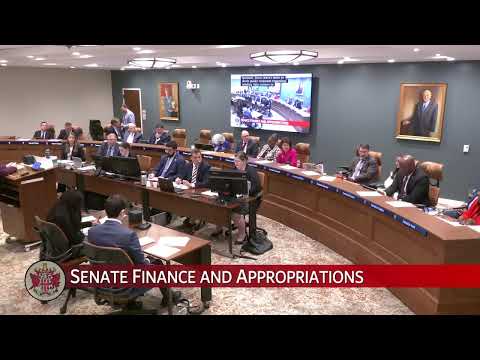
The Senate conferees presented a compromise budget proposal in a June committee meeting that would impose a tiered state impact fee on data‑center generators and use the money to support teacher raises, Medicaid and a series of one‑time investments while preserving contingency reserves.
The Chair framed the package as a negotiated compromise and said it aims to ensure ‘‘data centers pay their fair share’’ while allowing conferees to meet the House and the governor immediately after the session to try to finish a budget before the June 30 deadline. The Chair said the proposal was intended to respond to citizen concerns over exemptions and the local impacts of data‑center development.
Under staff calculations presented to the committee, the impact fee is a generator‑based charge remitted quarterly to the Department of Taxation and deposited into the General Fund. Staff described a tiered structure: roughly $45 per permitted kilowatt‑hour for higher‑emission (tier‑one) generators, $37 per kWh for certain tier‑two generators or retrofits and $35 per kWh for tier‑four generators; the fee would take effect Jan. 1, 2027. Staff projected the fee could generate roughly $1.7 billion on an annualized basis in steady state (about $600 million in a prorated first year and roughly $1.1–$1.2 billion in year two, according to staff estimates introduced at the meeting).
The proposal packages that revenue alongside roughly $922 million of reforecasted revenue for FY27–28 and other resource actions. Staff said the total additional resources relative to the introduced budget total about $4.5 billion, including one‑time balances and carry forward items. The conferees’ plan includes a mix of ongoing and one‑time investments and leaves a modest unappropriated balance in the multi‑year plan.
Key spending elements highlighted by staff include a 4% annual teacher pay increase (about $770.8 million GF over the biennium, per staff), sizable increases for Medicaid and children’s health coverage (staff cited roughly $7 billion over the biennium to cover rising health costs, with about $2 billion state‑funded), $75 million for the Housing Trust Fund, $50 million for child care and $250 million reserved for environmental impact monitoring tied to data‑center concerns. The budget also includes a ‘‘fair share’’ tax rebate and a standard deduction increase targeted at lowering tax burdens for households.
Senators questioned the administration and staff about MOU limits tied to the existing data‑center sales and use tax exemption and whether the fee would run afoul of those agreements. Staff described the fee as an alternative pathway to generate revenue without directly amending the exemption language in the budget and noted language in the proposal that would require additional data reporting to the State Corporation Commission and Department of Taxation.
Chair and staff repeatedly described the document as the Senate conferees’ compromise: it preserves many Senate priorities while incorporating several House proposals. No formal floor vote was recorded in the committee transcript; conferees said they would meet with House conferees immediately after the session to continue negotiations.
The committee hearing closed after additional questions about revenues, implementation timing and how the new fee revenue would be allocated. The meeting produced a staff plan and policy outline that conferees said they will take into inter‑chamber negotiations but did not finalize as a conference report in the hearing.