Get Full Government Meeting Transcripts, Videos, & Alerts Forever!
Get email alerts on the Downtown Realignment topic
No spam. Unsubscribe anytime.
Planning commission advances city‑owned and gateway changes in downtown plan, delays final incentive package
Summary
The commission approved staff recommendations to permit flexible use of city‑owned downtown parcels and to raise gateway-site development standards (130 ft/5.0 FAR) while requiring development agreements for large commercial projects, and continued the broader downtown incentive package for more refinement.
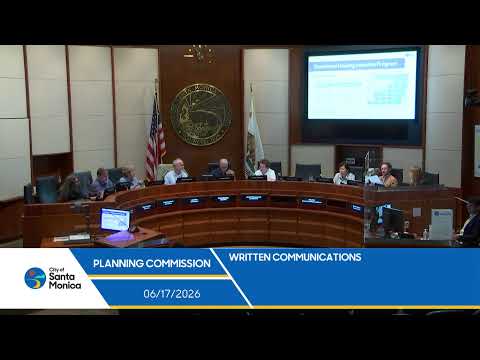
On June 17, 2026 the Santa Monica Planning Commission approved parts of the city’s Realignment Plan implementation focused on downtown economic recovery while continuing other elements for additional study.
The commission voted to: (1) exempt city‑owned downtown parcels from the city’s standard zoning framework so the city can pursue site‑specific disposition and development that maximizes public benefit; and (2) raise base development standards for three gateway master‑plan parcels to 130 feet and 5.0 floor‑area ratio, but require development agreements (DA) for commercial projects larger than 30,000 square feet so the city retains power to negotiate community benefits. Commissioners agreed housing projects within gateway sites could proceed through a streamlined ministerial review, but large commercial proposals would need a DA.
Why it matters: Staff said the Realignment Plan aims to concentrate housing and economic activity in the downtown core while protecting low‑scale neighborhoods elsewhere in the city. Raising base standards and offering a local bonus are intended to make downtown projects financially feasible and speed construction as market conditions allow.
Program details under discussion: Staff proposed a ministerial downtown housing incentive program with stricter unit‑mix expectations in exchange for a local density bonus. The eligibility concept would require a market‑rate unit mix with 15% of market units as two‑ or three‑bedrooms and limit studios to 50% of total units; developers could comply on‑site (15% at 80% AMI), off‑site (15% at 80% AMI), or by paying a fee‑in‑lieu. Staff recommended increasing base height/FAR across most downtown zones (to 130 ft / 5.0 FAR, excluding LT East and WT transition zones) so the density bonus has a larger base to apply against.
Commissioners and public commenters raised several concerns. Labor representatives from United Here Local 11 urged retaining development agreements for commercial projects on public and gateway sites to secure enforceable community benefits and to avoid commercial projects crowding out housing. Neighborhood advocates and commissioners pressed for protections for legacy commercial tenants and for neighborhood commercial corridors (the “boulevard” program) that were removed from the current review package and will be returned via a new ROI (request for instructions) for further analysis. Several commissioners said the Bayside Promenade historic core should be treated sensitively and suggested excluding it from the largest height increases.
Following discussion the commission: approved staff recommendations for city‑owned site flexibility; approved the gateway‑site amendments with the DA requirement for commercial projects above 30,000 sq ft; and continued the downtown incentive and upzoning package for additional refinement, including direction to staff to (a) analyze how to avoid “double‑dipping” when off‑site affordable units are used, (b) consider a ratcheted affordability requirement for higher heights, and (c) examine commercial tenant‑protection options in light of recent state law. The commission also asked staff to return with clearer incentive numbers and redlines for council review.
Next steps: Staff will forward the city‑owned and gateway recommendations to City Council for consideration (Council meeting July 14, per staff schedule) and will return to the commission with revised language on the incentive package and a new ROI on boulevard‑scale options and commercial tenant protections.
Public testimony quoted: labor representative Jonah Brezlau said requiring DAs for commercial uses would "ensure the city retains the maximum ability to negotiate and enforce substantial community benefits." Neighborhood Task Force representative Heather Thomasson urged the commission not to drop the boulevard program, noting small local businesses and neighborhood character need protections.
The commission’s votes produced a clear path for city‑owned parcels and gateway sites while leaving the more technical affordability ratios and bonus mechanics for further study.