Get Full Government Meeting Transcripts, Videos, & Alerts Forever!
Get email alerts on the Sb79 Exclusion topic
No spam. Unsubscribe anytime.
Planning commission recommends short-term SB79 exclusion, urges targeted upzoning for Expo/Bundy
Summary
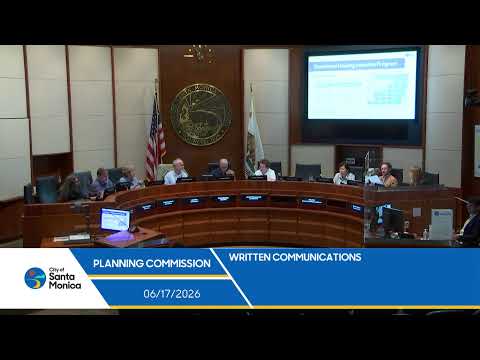
On June 17 the Santa Monica Planning Commission voted to recommend that City Council adopt a temporary ordinance excluding many local parcels from SB79’s automatic upzoning, and advised targeted upzoning (Option 2) in the Expo/Bundy TOD zone to qualify that area for exclusion; staff will submit the ordinance to council June 30 for a July 14 hearing.
On June 17, 2026 the Santa Monica Planning Commission voted to recommend that City Council adopt a temporary local exclusion ordinance to limit the immediate reach of Senate Bill 79 (SB79), and endorsed a targeted upzoning approach—Option 2—for the Expo/Bundy transit neighborhood to meet the state’s exclusion criteria.
Planning staff, led by Anna Fernandez and Rachel Clark, told the commission that SB79 takes effect July 1 and automatically increases allowable height and density for qualifying projects within a half‑mile of major transit stops. Fernandez said the city had consulted with the state Housing and Community Development Department (HCD) and the Southern California Association of Governments (SCAG) to identify which transit stops qualify under SB79’s criteria. “The law essentially will upzone the areas within a half mile of all qualifying transit stops,” Fernandez said in the presentation to the commission.
Why it matters: SB79 creates a permissive, statewide pathway for housing near transit; local jurisdictions may pass exclusion ordinances if they can show the internal capacity and site characteristics required by the statute. The commission’s recommendation aims to buy the city short‑term time to pursue a locally tailored TOD alternative while minimizing abrupt changes in low‑scale neighborhoods.
Staff described a three‑part test for sites that can be excluded, explained how they modeled each parcel’s local capacity versus SB79 capacity, and identified three downtown bus stops that staff believe meet SCAG/HCD criteria. Rachel Clark summarized modeling results showing most Santa Monica TOD zones exceed SB79 capacity thresholds but noted the Expo/Bundy TOD zone fell short because many parcels lie in the City of Los Angeles or because Santa Monica parcels there are large and therefore count as fewer "sites." Clark said staff’s two policy choices for Expo/Bundy were: Option 1, a narrow upzone of 19 R1 and 1 R2 parcels to 1.5 FAR/50 du/acre; or Option 2, a broader upzone of R2 and R3 parcels to 1.25 FAR/40 du/acre covering about 59 parcels. Staff recommended Option 2 as the more reliable path to meet the law’s 33% site threshold.
Public commenters and commissioners pressed staff on displacement and legal risk. Longtime nearby residents described noise, late‑night events and alleged conversions at a property near the Third Street Promenade; Laura Wilson provided a packet of documents alleging the property had been operated as apartments and raised questions about prior rent‑control decisions. Staff responded that an open code‑enforcement case exists and that staff had met with new management and ownership. Resident Matthew Hley told commissioners, “Our home has really been destroyed,” describing late parties, lighting and valet parking beneath bedroom windows.
Commissioners debated SCAG’s draft mapping and how to treat bus stops (whether a short bus pull‑out is a “dedicated bus lane” for the statute), whether Los Angeles parcels within the Expo/Bundy radius should count toward Santa Monica’s site thresholds, and how rent‑stabilized units factor into capacity calculations. Staff explained HCD treats demolition of rent‑restricted units as a project‑level exclusion (projects that would demolish three or more controlled or affordable units do not qualify), but capacity counts still include those parcels because protections can lapse or change over time.
After deliberation, the commission voted to recommend that City Council adopt the exclusion ordinance and instructed staff to pursue Option 2 (the broader R2/R3 targeted upzoning) to qualify the Expo/Bundy TOD zone for temporary exclusion. The roll call recorded by the clerk was: Commissioner Fresco — yes; Commissioner Landress — yes; Commissioner Lambert — yes; Commissioner Reese — no; Commissioner Wasserman — no; Vice Chair Choco — yes. The motion passed and staff said they would submit a draft ordinance to City Council on June 30 for a July 14 public hearing. If adopted by council, staff must file the ordinance with HCD within 60 days and HCD has 120 days to review; staff estimated the exclusion would not take legal effect until roughly late August.
Next steps: City staff will finalize the ordinance text and the local map for Council review, continue consultations with HCD and SCAG on the bus‑stop determinations, and advance a parallel TOD alternative plan. Council will hold a hearing July 14; staff emphasized that SB79 becomes effective July 1, so some applicants could submit SB79‑eligible proposals in the short window before an exclusion takes effect.
The commission’s recommendation is advisory; City Council will make the final decision at its upcoming meeting.