Get Full Government Meeting Transcripts, Videos, & Alerts Forever!
Get email alerts on the Budget topic
No spam. Unsubscribe anytime.
Natomas Charter board opens public hearing on 2026–27 budget, staff warn of state volatility and new leave costs
Summary
At its June 15 meeting the Natomas Charter School Board opened a public hearing on the 2026–27 budget. Staff projected roughly $29.6 million in revenue, a $25 million fund balance and warned that a proposed paid pregnancy-disability leave and state holdbacks make the outlook volatile.
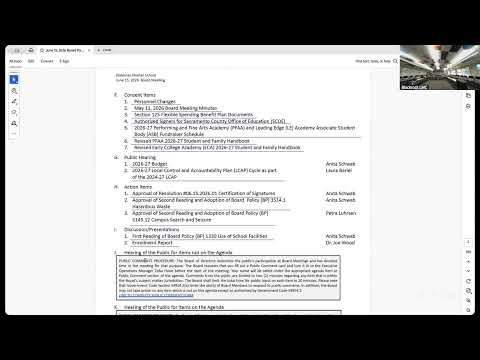
At its June 15 meeting the Natomas Charter School Board opened a public hearing on the 2026–27 proposed budget and heard a detailed staff presentation on the district’s fiscal outlook.
Finance staff presented a draft budget that projects about $29.6 million in revenues and roughly $29.7 million in expenditures for fiscal year 2026–27, leaving an estimated ending fund balance near $25 million. Staff described the local control funding formula (LCFF) as the largest revenue source, accounting for roughly 80% of projected revenue, and said the budget assumes a projected average daily attendance (ADA) of about 1,806 students.
The presentation focused on major assumptions and risks. The May state budget revision increased the statutory COLA and added a 1.44 percentage-point augmentation — a combined 4.31% boost staff called an “ongoing” increase — but the state attached expectations and new requirements. Anita, the outgoing finance director, said the administration modeled a proposed paid pregnancy-disability leave (PPDL) that would cover 14 days of paid pregnancy leave and estimated the local cost for 2026–27 at roughly $150,000; she noted new revenues in the budget exceed $200,000 but cautioned actual allocations will depend on final trailer bills.
“We included an estimate for paid pregnancy-disability leave in this year’s numbers,” Anita said, adding that the district averaged roughly four maternity leaves over recent years and modeled the impact conservatively. She told trustees the augmentation helps offset that expected cost but that the program’s final scope remains contingent on legislative action.
Board members pressed staff on contingency plans if one-time state funds do not persist. At least one trustee asked whether certificated reductions were likely; staff reiterated that the draft assumes a conservative posture and that up to four certificated FTE reductions are listed as a possible adjustment in later years pending the state’s final actions. “We intentionally built our budget as conservative as possible,” a staff member said, noting the district could defer to reserves or adjust non‑personnel spending if revenues fall short.
Staff also reviewed special education funding increases, projections for CalSTRS/CalPERS contributions, and planned investments in technology, PBIS expansion and summer programs. The presentation noted the district is holding roughly $6 million in cash reserves as part of its fund balance and is meeting its fiscal-reserve target (approximately 35% of operating expenses). Staff projected positive monthly cash through the year despite a delayed June cash deferral.
Trustees requested follow-up updates after the Legislature completes final budget negotiations and trailer bills; staff said they will revisit the figures in August and again at first interim reporting. No vote was taken; the public hearing was opened and closed on the record to permit the presentation and will return for formal adoption at the next meeting.
What’s next: staff will monitor the legislative process for trailer bills and revised allocations, update the board in summer, and return to the board with a final adopted budget and the LCAP for approval at the scheduled meeting in late June.