Get Full Government Meeting Transcripts, Videos, & Alerts Forever!
Get email alerts on the Sidewalk Project topic
No spam. Unsubscribe anytime.
Mansfield conservation commission backs South Eagleville sidewalk with mitigation conditions
Summary
The commission recommended support for the town’s plan to extend a sidewalk on South Eagleville Road between Maple and Separatist roads, concluding impacts to a flagged drainage swale could be mitigated if erosion controls, best-practice vegetation mats and a reconstruction plan for the ditch are implemented; a public hearing is set for July 20.
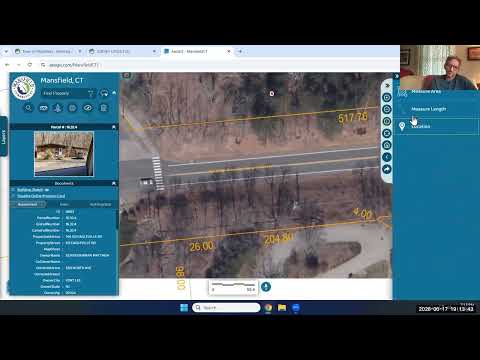
The Mansfield Conservation Commission on June 17 recommended that the town proceed with a Department of Public Works application to extend a sidewalk on the south side of South Eagleville Road from Maple Road to Separatist Road, provided the project’s proposed mitigation and erosion-controls are implemented.
Commission members said closing two remaining gaps in the town sidewalk network will improve pedestrian safety along a steep section of South Eagleville Road, where people currently run or walk in the travel lane. Staff and members noted the town previously allocated funding and completed design work for the downtown loop closure; the South Eagleville section was described as the last piece of that plan.
Why it matters: the proposed alignment crosses a narrow, flagged drainage ditch that the town’s consultant classified as an intermittent watercourse that conveys stormwater. The feature was flagged by Davidson Environmental; the town’s plan would relocate the swale about eight feet to the south, install a retaining wall where slopes are steep, and reconstruct a scour protection feature on the opposite side of the road to prevent excess scour into nearby wetlands.
Commissioners pressed staff for clarity on whether the relocated channel would preserve existing hydrologic function. They asked staff to confirm the wetland scientist’s functions-and-values assessment and to require construction measures that minimize turbidity and sediment transport during and immediately after construction. Members discussed using biodegradable vegetation blankets (coconut matting), hay bales at outlets and straw mats while seeding establishes, and explicitly discouraged vegetation mats that contain plastic mesh.
Action taken: Chair Michael Sor moved and James Nighton seconded a motion to support the project as proposed with the condition that the mitigation and erosion- and sediment-control measures be implemented as specified; the motion was adopted in the meeting (the transcript records members Aaron King and Chad Writtenhouse as explicitly answering in favor; the record does not contain a full roll-call tally). The commission also recommended avoiding plastic-mesh vegetation mats and urged the use of coconut matting or similar biodegradable materials until plantings establish.
Next steps: staff said the public hearing on the application is scheduled for July 20, giving the commission time to request supplemental data, to ask its wetland scientist to opine on functions lost or maintained by the proposed relocation, and to seek additional detail on erosion-control sequencing.
Context and background: Commission members said the sidewalk project is part of a multi-phase downtown loop closure; earlier culvert work on Hunting Lodge Road was described as phase one of a broader project. The flagged drainage feature was called an intermittent conveyance that flows after storms and is vegetated primarily with reed canary grass and swamp fern, which led members to treat it differently than an intact wetland basin.