Get Full Government Meeting Transcripts, Videos, & Alerts Forever!
Get email alerts on the Water Rate Policy topic
No spam. Unsubscribe anytime.
Staff models a fourth water-rate tier; analysis shows limited revenue gain, council asks for materials
Summary
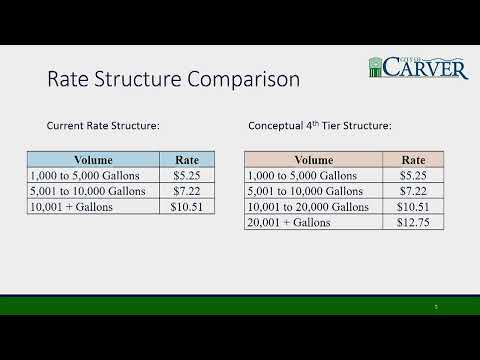
Staff presented 2025 water-usage data and a conceptual fourth conservation rate tier targeted at very large users; modeling indicates the new tier would shift revenue but generate only about $20,000 in additional operating revenue in the modeled scenario, and council asked staff to distribute the PowerPoint and return with follow-up analysis.
City staff presented a data-driven review of the water rate structure at the June 15 work session, proposing a conceptual fourth tier aimed at very large monthly users and summarizing 2025 usage patterns across account classes.
The presenter reported the city's account mix: 2,270 residential accounts, 37 combined industrial/commercial accounts, 25 irrigation accounts and 23 multi-home accounts. Staff ran frequency counts of monthly usage bands and found the city logged many higher-usage irrigation months: "We billed 1,348 residential times over 15,000 gallons and 578 times over 20,000 gallons in 2025," the presenter summarized to illustrate how consumption clusters into higher bands during irrigation season.
Modeling and revenue impact: staff walked council through a conceptual fourth tier intended to target very high-use accounts. The model did not substantially increase overall operating revenue under the base assumptions; staff estimated the new tier would shift collection toward higher users and produce roughly $20,000 of additional revenue in the modeled scenario. Staff described the tier as primarily a conservation and demand-management signal rather than a major revenue source.
Why it matters: a fourth tier could change user incentives during dry years and shift more of the rate burden onto very large users (irrigation and multi-home accounts), but it is weather-dependent and will vary year to year.
Next steps: council asked staff to distribute the presentation materials and revisit the proposal during the council meeting after a short digest period; staff agreed to provide the PowerPoint and follow-up data so members can evaluate options and any equity effects across account types.