Get Full Government Meeting Transcripts, Videos, & Alerts Forever!
Get email alerts on the Traffic Calming topic
No spam. Unsubscribe anytime.
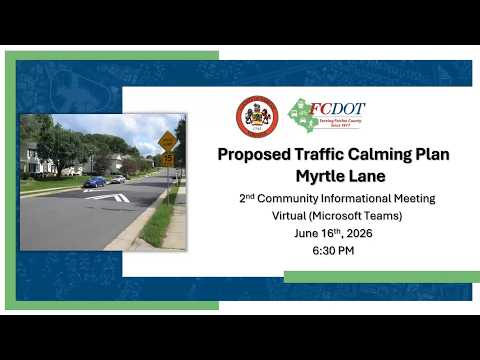
Fairfax County officials present Myrtle Lane plan proposing three speed tables; neighbors debate cost, data and ballot area
Summary
Fairfax County Department of Transportation presented a plan to install three speed tables on Myrtle Lane after a traffic study found 523 vehicles per day and 85th-percentile speeds of 34/37 mph; the county will ballot 99 occupied properties and needs a majority of issued ballots to vote yes to proceed. Residents questioned cost, data collection and inclusion of nearby Handlebar Road in the ballot area.
Fairfax County Department of Transportation staff on a community call laid out a traffic-calming plan proposing three speed tables on Myrtle Lane and answered questions about data, device placement and the upcoming ballot.
Nicole McChalk White of FC DOT explained that the county’s traffic-calming program requires a VDOT-maintained road with a 25 mph limit and that Myrtle Lane met the county’s criteria: "So, for Myrtle Lane, we had 523 vehicles, so we met the volume criteria," she said, and staff reported 85th-percentile speeds of 34 mph northbound and 37 mph southbound, with the southbound direction meeting the county’s threshold for calming measures.
The plan calls for three speed tables spaced along the roadway; staff showed a schematic (22 feet long and about 3 inches high at center) and said adjacent-property owners directly next to any proposed device must sign off on placement. If the ballot passes, FC DOT will present the plan to the Fairfax County Board of Supervisors for endorsement and send a resolution to the Virginia Department of Transportation for acceptance before coordinating installation with county public works.
The ballot will be distributed to the 99 occupied properties in the ballot area and remain open for at least three weeks. FC DOT staff clarified the approval rule: the plan requires more than 50% of the issued ballots to be voted 'yes' to move forward; staff confirmed that ballots not returned will be treated as 'no.'
Task force member Cara Earhart, who helped coordinate the neighborhood effort, told the meeting that speed tables are less jarring than typical speed bumps and that she was able to traverse similar county speed tables in a larger vehicle: "I tested it with our Volkswagen... we were able to go over those at 25 miles an hour." Earhart said one proposed location was removed because a property owner adjacent to the placement declined to sign the required authorization.
Several residents questioned aspects of the study and the plan. Chris Lamb asked about costs and opposed the proposal: "I do oppose the installing these. I just... think the money could be better spent in other areas," and staff estimated total construction for the three devices to be in the range of $45,000 to $60,000. Other participants proposed alternatives such as increased enforcement, additional signage, company outreach to drivers of heavy vehicles, or stop signs (which FC DOT said fall under VDOT review and are typically used to control intersections rather than operating speeds).
Some attendees raised concerns about the data used to qualify the road. One participant noted that traffic counts were taken between Running Cedar and Lawyers Road and questioned whether those counts reflect traffic at the device locations; FC DOT staff said they used a 24-hour throughput count (their standard practice) and did not collect turning-movement counts for Running Cedar. When asked why FC DOT uses 24-hour counts and a 500-vehicle minimum while VDOT typically cites 48-hour counts and a 600-vehicle threshold, staff said the county lowered its minimum with Board endorsement and submitted its methodology to VDOT for review and clearance.
Residents also debated which properties belong in the ballot area. Participants questioned why 47 properties on nearby Handlebar Road were included when they are not adjacent to a device; staff explained that the ballot area includes properties that rely on the subject road for access, not only those immediately adjacent to a device.
FC DOT posted contact information for follow-up questions and for the Hunter Mill District Supervisor's office and encouraged neighbors to inspect existing nearby installations (staff cited Tolston Road — also noted in the chat as 'Tolsen Road') as an example of county speed tables. Staff reiterated how to submit ballots and that the task force will distribute approved ballot packages to occupants in the ballot area.
The meeting closed after more than an hour of presentation and community discussion. If the task force decides to proceed to the ballot, residents in the ballot area will receive voting materials and the county will publish results after tallying.