Get Full Government Meeting Transcripts, Videos, & Alerts Forever!
Get email alerts on the Education Policy Grading topic
No spam. Unsubscribe anytime.
After hours of debate, board moves grading policy details to administrative regulation and removes contested 85/15 language
Summary
Trustees voted unanimously to put the detailed implementation language of BP/AR‑5121 into an administrative regulation, adopt a high‑level board philosophy for grading, and strike a disputed 85/15 formula that teachers and union representatives said caused confusion.
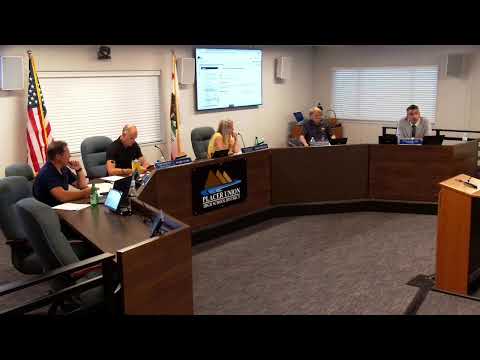
Following more than two hours of public comment, teacher testimony and trustee debate, the Placer Union High School District Board of Trustees voted unanimously to revise how it governs grades and evaluation (BP/AR‑5121).
Under the amended motion the board adopted a concise ‘‘board philosophy’’ paragraph into board policy and directed staff to move the remainder of the detailed language into an administrative regulation (AR) that administrators and an ad‑hoc committee will refine and use to guide implementation. The board also struck a recently added ‘‘85/15’’ formulation — language that several teachers, administrators and union representatives said was ambiguous and led to confusion about how essential learning outcomes (ELOs), formative work and summative assessments are weighted in practice.
"What we want is steady waters and something our teachers can run with," Trustee Underwood said during the debate. Teachers testifying during the meeting described concrete grading‑book practices, concerns about parent communication and the need for clear training: "I just feel like it hasn't been really given the time that it deserves to make sure that it's spelled out in an actual way I can take and use," one teacher said.
Board members framed the vote as an effort to preserve the board's philosophical direction on grading — fairness, transparency and student mastery — while giving administrators the flexibility to address implementation details and provide training in real time. Staff cautioned that operational changes would be phased in and that the existing policy and grade‑book tools (e.g., the district’s gradebook status flags) would be used during the coming school year while the AR is refined.
Trustees asked staff and the ad‑hoc committee to return with clarifications on how incomplete grades, ELOs and communication to families will be shown in the grade system and to report back recommended AR language before major rollouts.