Get Full Government Meeting Transcripts, Videos, & Alerts Forever!
Get email alerts on the School Facilities topic
No spam. Unsubscribe anytime.
Westford Public Schools outlines Robinson School feasibility study, MSBA partnership and consolidation options
Summary
At a community forum, Westford Public Schools and consultants reviewed a feasibility study focused on the Robinson School, MSBA reimbursement (48% of eligible costs), three enrollment scenarios (preK–2; ~705; ~1,065) and four short-listed town-owned sites; consultants flagged environmental, wastewater and code-upgrade costs and said schematic designs and cost estimates will precede a fall town vote.
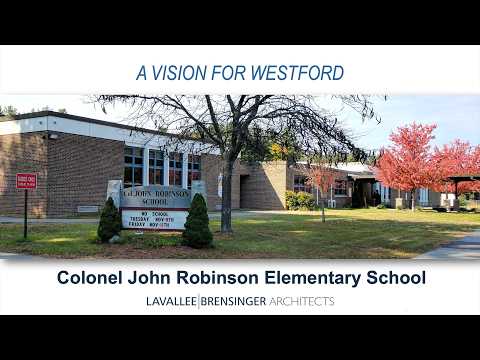
Westford Public Schools officials and consultants presented preliminary findings from a feasibility study focused on the Robinson School at a community forum, saying the 2023 SMMA facilities assessment identified Robinson as having the district’s most pressing needs and that the Massachusetts School Building Authority (MSBA) has invited the district into its process and will reimburse 48% of eligible costs.
The district is studying three enrollment scenarios: replacing Robinson as a preK–2 school and keeping the existing six elementary schools; consolidating two schools into approximately 705-student preK–5 schools (reducing the district to five elementary schools); and a larger consolidation that would produce roughly 1,065-child preK–5 schools and reduce the district to four elementary schools. The study team stressed that each enrollment scenario carries different building-, site- and district-wide implications, including redistricting, busing and parking.
"Robinson's outdated open suite floor plan. It's a major challenge," the moderator said, summarizing why the site rose to the top of the district’s list. Consultants noted many of Robinson’s building systems are at or near the end of their useful life: HVAC, electrical and plumbing systems will require replacement in any renovation; the roof and interior finishes are due for renewal; modular classrooms (about 26 years old) should be replaced; and code upgrades such as sprinkler systems would be required.
The team reviewed four town-owned sites that remain under study: the Robinson site, the Abbott site, the Day School site (included because MSBA requires an analysis even though consultants described it as largely unbuildable), and the Stony Brook Recreational Fields, which was recently added. Consultants said they screened an initial list of 18 candidate parcels (privately and publicly owned) and narrowed the list because MSBA participation requires town site control.
Environmental and utility issues factored into the early cost picture. Presenters said Robinson contains wetlands and a stream that constrain buildable area, has minimal stormwater infrastructure, and hosts an underground fuel storage tank that will almost certainly need removal and possible soil disposal; consultants said they will conservatively assume some contaminated soils in early cost estimates until sampling is completed. At Abbott, the on-site wastewater treatment plant lacks excess capacity, so any scenario adding students there will require added wastewater treatment capacity and associated cost.
Project schedule highlights provided by the team call for completion of the preliminary design program and development of cost estimates, a preferred schematic report and schematic design beginning in December and running through the following summer to produce a solid cost estimate. The team said it will prepare for a town meeting and debt-exclusion vote in late October–early November, with additional community meetings for visioning and redistricting analysis before the vote.
Consultants and district leaders encouraged continued community input and flagged several technical next steps: more detailed cost estimating, geotechnical and environmental sampling where needed, redistricting maps tied to each enrollment option, and further traffic observations and counts to support routing analyses. The district noted that MSBA will reimburse eligible project costs, but that certain off-site infrastructure improvements (new sidewalks, signals, or intersection work) may be community-level expenses that fall outside full MSBA reimbursement.
The feasibility study is ongoing; the team said it will return with refined options, test fits for each short-listed site, estimated project budgets, and redistricting implications before the town votes on any debt-exclusion funding.