Get Full Government Meeting Transcripts, Videos, & Alerts Forever!
Get email alerts on the Fairmount Reorganization topic
No spam. Unsubscribe anytime.
Bangor School Committee approves one-year ‘school within a school’ plan to relocate Fairmount students to Bangor High
Summary
The committee voted to approve Option Two, a one-year plan to move Fairmount students and staff to the lower A wing of Bangor High School for 2026–27, while committing to a summer and fall process for longer-term facilities planning, transportation details, and community engagement.
The Bangor School Committee on May 28 approved a temporary “school within a school” plan to relocate Fairmount students and staff to the lower A wing of Bangor High School for the 2026–27 school year.
Superintendent Robinson presented Option Two under the authority of Maine statute 20‑A, part two, chapter 101, section 1018, recommending the move as a short‑term response to Fairmount’s current facility challenges and stressing that the change is temporary while district leaders pursue a longer‑term facilities plan. "Fairmount students will have dedicated classrooms in lower A hallway of Bangor High School," Robinson said, adding that the plan includes "dedicated bathrooms, a play space, music, art, library, and PE" and that "safeguards such as secure doors with key card access will be installed over the summer."
The recommendation drew extensive public comment from parents and residents. Josh Bridges, a Bangor resident and parent, said the community needs a clearer long‑term vision before evaluating short‑term choices: "What is the long‑term goal? Are we ultimately moving toward a consolidated school system, or are we committed to preserving the community schools?"
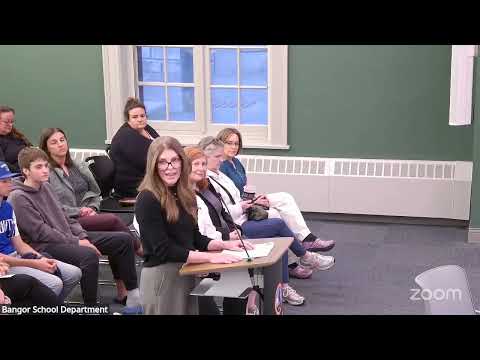
Several parents described practical and equity concerns. Megan Anderson, a Fairmount parent, said the move will be "a significant disruption" for about 250 Fairmount students and warned the plan should not be celebrated as a long‑term solution. "The district has undoubtedly failed current and future Fairmont students," she said, urging transparent, collaborative planning going forward. Aaron Porter raised transportation and scheduling challenges for families with multiple children and noted special‑needs considerations, saying long bus rides can be harmful for some students.
Committee members pressed for specific operational details before and after the vote, focusing on safety, equity, transportation, and programming continuity. Member Speed asked whether services such as IEP supports, nursing, and multilingual services would continue; the superintendent replied that those programs "follow the students" and that the 21st Century program would continue. On safety, a committee member pointed to local precedents for housing wide age ranges in one campus and said there is "no evidence" these models create elevated risks when implemented with separation and fidelity.
The superintendent outlined a summer implementation schedule: engineering/contractor work to finalize facility needs, a draft strategic analysis to be shared June 24, orientation planning and open houses likely the week of Aug. 17, bimonthly summer communications on a dedicated web page, and bus‑route finalization to occur with SEIR over the summer.
After questions and member discussion about communication, mitigation, and neighborhood outreach, the motion to adopt Option Two was moved, seconded, and approved by voice vote.
What the vote does and does not do
- The approved plan is explicitly a one‑year, temporary reorganization for the 2026–27 school year. Superintendent Robinson and several members repeatedly framed the action as a short‑term response while the district pursues a multi‑year facilities strategy. "This is a temporary solution and the beginning of a deeper conversation related to overall educational experiences of all of our students," Robinson said.
- The committee directed staff to finalize operational plans this summer, including specifics for dedicated bathrooms and access control, orientation and open‑house dates, bus routing, staff packing and supports, and communications to families. Robinson said staff will prepare signage, schedules, FAQs, and multiple open‑house times for families.
Community reactions and next steps
Parents expressed a mix of relief and trepidation: some supported the plan as the least disruptive option; others urged the committee to continue robust engagement and to avoid treating the one‑year move as the final solution. Several committee members urged active outreach to neighborhoods not yet engaged and formation of working groups that include parents, students, teachers, and administrators to monitor and refine the plan.
The superintendent also committed to a facilities presentation in August with engineering studies and cost estimates and said the draft strategic analysis will be presented to the committee on June 24. The committee set the next regular meeting for June 10 and scheduled additional planning and community engagement through July and August.
The committee did not provide a detailed, itemized final cost for the temporary relocation during the May 28 meeting; members said financial specifics and engineering scopes would be presented in August. The vote recorded that the motion passed by voice (committee stated "7‑0" in the meeting record).