Get Full Government Meeting Transcripts, Videos, & Alerts Forever!
Get email alerts on the Land Use topic
No spam. Unsubscribe anytime.
City adopts a wide Land Development Code update, bars data centers citywide and clarifies mobile food‑unit alcohol rules
Summary
After extensive debate and dozens of amendments, City Council adopted a broad Land Development Code and design manual package; the council also voted to prohibit data centers citywide (4–3) and approved definitions and new rules clarifying when mobile food units can satisfy restaurant requirements for an alcohol conditional‑use permit.
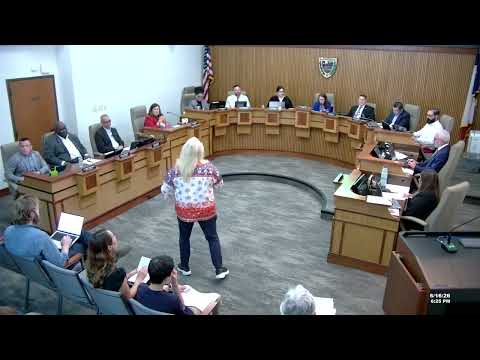
San Marcos City Council completed a long agenda item June 16 to adopt a comprehensive update to the city's Land Development Code (LDC) and design manual and to consider a set of council‑sponsored and staff edits addressing issues from qualified watershed protection plans to mobile food units and alcohol conditional‑use permits (CUPs). After a series of staff presentations, public testimony and repeated council amendments, the council adopted the overall LDC package 7–0.
Key outcomes and changes:
- LDC Adoption: Council adopted the development code and associated design manual updates after numerous staff clarifications and council amendments; staff said the changes incorporate earlier May 5 council directions and suggested edits to streamline permitting and improve online transparency for certain watershed protection plans.
- Qualified watershed protection plans: Staff will remove the separate 'qualified' permit category that required an informational P&Z presentation and instead provide an online map viewer with plan details and provide a report to the Planning & Zoning Commission after administrative approvals; staff said this keeps technical standards in place while shortening the process.
- Mobile food units and alcohol CUPs: Council added a formal definition for "mobile food unit" (replacing older "food truck" language) and revised accessory‑structure and use standards. Council and staff discussed whether a mobile unit could be used as the kitchen that allows a brick‑and‑mortar operator to qualify as an "eating establishment" for an alcohol CUP. The CUP committee recommended against allowing a mobile unit to serve as the kitchen in downtown's Central Business Area (CBA); council adopted targeted carve‑outs for the downtown CBA (the council had already limited "bar" CUPs in the CBA). Staff also added clearer distance, material and site‑design standards for mobile units.
- Data centers: Amid a separate motion and debate, council voted to amend the land‑use matrix to prohibit data centers in all zoning districts; the motion passed 4–3 after members said the current technology and impacts (notably large on‑site generation or continuous noise or water use) merit a prohibition in the near term. Councilmembers who opposed the prohibition said they wanted to preserve the ability to review and approve projects via conditional use and cited evolving technology that could alter impacts.
- Electric on‑site generation and backup generators: Council and staff worked to clarify definitions for electric or gas on‑site generation, backup generation and large electric generation facilities; staff noted some state and federal preemption issues for transmission and interconnection and said additional wording will be refined as needed.
- Other edits: Council modified posting notice rules, clarified use standards for retail and personal services in downtown districts, and created or amended several code definitions and cross‑references to improve consistency.
Votes of note: the data center prohibition passed 4–3; the overall LDC package (with a set of staff and council amendments) was adopted unanimously 7–0. Council directed staff to implement the approved edits and to return with any additional technical clarifications, and flagged certain definitions for further refinement in the next amendment cycle.